
Tablet Storage Ideas That Keep Every Device Charged and Easy to Find
Tablet storage ideas are the fix for the tablet that is always somewhere you are not. It is on the couch when you need it at the desk, on the kitchen counter when the kids need it for homework, and in a bag somewhere when it is time to charge it. You own a device that is meant to be grabbed and used, and instead you spend two minutes every day hunting for it.
The tablet is not the problem. The missing home is. Tablets are thin, flat, and easy to set down anywhere, so they land wherever your hand happens to be — the arm of the sofa, the bedside table, the top of a pile of mail, the car seat. Nothing is wrong with any one of those spots, and together they add up to a device that is never charged, never where you need it, and one drop away from a cracked screen. That is the loop these tablet storage ideas break: every tablet gets one spot, one charger, and one routine, so the device is charged and waiting instead of lost and dead.
The fix is a small system, not a bigger desk. Pick one charging spot, give the daily tablet a stand or a drawer, keep the cables labeled and out of sight, and set a simple rule for the tablets that are not used every day. That is what good tablet storage ideas do — they put the device where your hand expects it, charged and ready, so you grab it and go instead of searching for it first.
This guide walks through the whole system: seven storage setups that work in a small home office, where each tablet actually belongs, the mistakes that leave tablets dead or damaged, and a checklist you can run in ten minutes tonight. Start with the charging spot. The rest will follow — and these tablet storage ideas will carry the rest of the way.

Why Tablets End Up Everywhere (but Nowhere Handy)
A tablet has no natural home. A laptop closes and sits on a desk. A phone lives in a pocket. A tablet is too big for a pocket and too flat for a shelf, so it drifts. It rides from the couch to the kitchen to the bedroom, and each stop leaves it a little further from its charger.
Every one of those stops has a cost. On the couch it slides between cushions and gets sat on. On the kitchen counter it collects crumbs and splashes. On the bedside table it charges with the wrong cable, or with no cable at all. A tablet that is always somewhere else is a tablet that is dead when you need it, and a dead tablet is just a thin piece of glass taking up space.
The drift grows because every tablet in the house shares the same problem. The work tablet, the kids’ tablet, and the old tablet you keep as a spare all compete for the same two outlets, and none of them has a spot of its own. A tablet charging station is the simple answer here: one fixed place where every tablet charges, every cable has a label, and nothing wanders off. That is the loop these tablet storage ideas break: one spot per tablet, one cable per spot, and no more hunting.
7 Tablet Storage Ideas That Actually Work
These seven tablet storage ideas cover every home shape, from a one-desk apartment to a house with three tablets and two kids. Pick the ones that fit your space. You do not need all seven — you need one charging spot, one daily home, and one rule for the spares.
1. One Charging Spot for Every Tablet
The simplest fix is also the best one: give every tablet the same charging spot, every day. Pick one corner of the desk, one shelf, or one small table, and put a multi-port charger there with one labeled cable per tablet. When the tablet is done for the day, it goes back to the spot. When you need it, it is there, charged.
Keep the spot small and fixed. A charging spot that moves around the house is not a spot at all. Label each cable with a small tag or a piece of tape — “work,” “kids,” “spare” — so nobody unplugs the wrong one. Our charging station organization ideas post shows the same one-home-for-power logic for phones and laptops too, so the tablet cables and the phone cables can follow one plan instead of two. That is tablet storage ideas at their simplest: one spot, one cable, no wandering.
2. A Stand on the Desk
A tablet stand turns a flat device into a second screen. Set the tablet upright on a small stand at the back of the desk, angled toward you, and it stops being clutter and starts being useful — a recipe open while you cook, a video call while you type, a reference page while you work. When you are done, the tablet stays on the stand, charged and in view, instead of sliding under a pile of papers.
Pick a stand that holds the tablet steady at a reading angle and leaves the charging port open, so the cable plugs in while the tablet stands. A tablet holder for desk use should grip the tablet without covering the screen, and it should be heavy enough not to tip when you tap the screen. A tablet stand is also the cheapest way to keep a tablet off a hot laptop vent or a coffee ring — up in the air, where it belongs. That is a small win that tablet storage ideas deliver every day: the tablet visible, charged, and out of the way.
3. A Drawer With Dividers
Not every tablet needs to be on display. The spare tablet, the one the kids use only on weekends, or the old one you keep for recipes can live in a drawer — but only if the drawer has dividers. A bare drawer is where tablets go to get scratched by keys, buried under cables, and forgotten for months.
A tablet drawer organizer is a set of dividers or a padded tray that gives each tablet its own slot, with the charger tucked beside it. Cut foam or felt to line the slot if the drawer is hard wood, and keep the cable coiled in its own small section so it never wraps around the tablet. Label the slot if more than one tablet shares the drawer. That is tablet storage ideas working quietly: the tablet protected, the cable untangled, and the drawer closed on a tidy system instead of a tangle.
4. A Shelf by the Door
Some tablets are grab-and-go devices — the one that rides to school, to the car, or to the kitchen for recipes. Those tablets belong on a tablet shelf by the door, not buried in a desk drawer. A small wall shelf or a narrow floating shelf near the entryway, with a charging cable run to it, means the tablet is charged when you grab it and back on the shelf when you return.
Keep the shelf shallow, so the tablet leans against the wall without sliding, and keep it to one tablet per shelf. A shelf with three tablets stacked on it is a shelf that drops one. Our fall home office organization ideas post shows the same shelf-first logic for a seasonal desk reset, and the rule holds here too: the device you grab most lives closest to the door. That is tablet storage ideas for busy mornings — the tablet you need is the one you see first.
5. A Case System That Travels
A tablet without a case is a cracked screen waiting to happen, and a case without a home is just another thing to lose. A tablet case organizer is a small pouch or a zippered sleeve that holds the tablet, its charger, and its stylus together as one kit. The kit lives on the desk stand or the door shelf, and when the tablet travels, the whole kit travels with it — no hunting for the charger at the other end.
Keep one case per tablet, and keep the case closed when the tablet is inside it. A case that holds the tablet plus a pen, a cable, and a pair of earbuds is a kit, not a bag of loose parts. Label the case if the tablets look alike. That is tablet storage ideas that travel well: one kit, one grab, and nothing left behind on the kitchen table.
6. A Kids’ Tablet Home With Rules
Kids’ tablets need the firmest home of all, because kids set things down wherever they stop using them — the floor, the toy box, the back seat. Kids tablet storage works best as a single rule the whole family can repeat: when the tablet is done, it goes back to its spot, plugged in, every single time. Pick the spot together — a low shelf, a drawer they can reach, a charging cubby in the living room — and make it the only spot.
Give the kids’ tablet its own charger and its own cable, labeled with their name, so they never borrow yours and leave it dead. Set a charging time, too: the tablet charges overnight in its spot, not under a pillow or in a bed. A low shelf with a small basket for the case and the cable keeps the whole kit in one place, and a two-minute tidy-up at the end of the day keeps the rule alive. That is tablet storage ideas that teach a habit, not just a hiding place: the tablet has a home, the kids know it, and the morning starts without a search.
7. A Long-Term Storage Routine for Spare Tablets
The spare tablet — the old one, the one you keep for guests, the one waiting for a trade-in — needs a different kind of home. It should not sit dead in a drawer for a year, because a battery stored flat can fall into a deep discharge and never hold a charge again. The fix is a routine, not a spot: store tablet safely by charging it to around half, powering it down, and putting it in a cool, dry place, then topping it up to half again every six months.
Apple’s own battery guide says to store a device long term at around 50% charge, powered down, in a cool, moisture-free spot under 90° F, and to charge it back to 50% every six months if it sits longer than that — that is the routine to follow for any tablet you are not using daily, and the full guide is on Apple’s battery page. Keep the spare in its case, in a drawer or a box away from heat and damp, with its cable taped to the case so the kit stays together. Write the storage date on a small label, and set a phone reminder for six months out. That is iPad storage done right, and it works for any brand: half charged, powered down, cool and dry, checked twice a year.
Where Each Tablet Belongs
Use this table when you set up the system — it is tablet storage ideas in one glance. Tape it inside the desk drawer next to the checklist, and every tablet in the house gets a home.
| Tablet | Home | Charger |
|---|---|---|
| Daily work tablet | Desk stand, plugged in | Labeled cable at the desk |
| Kids’ tablet | Low shelf or cubby, plugged in overnight | Own cable, labeled with their name |
| Kitchen / recipe tablet | Door shelf or kitchen stand | Cable run to the shelf |
| Spare / old tablet | Drawer with dividers, in its case | Taped to the case, half charged |
| Travel tablet | Zippered case kit, on the door shelf | Cable inside the kit |
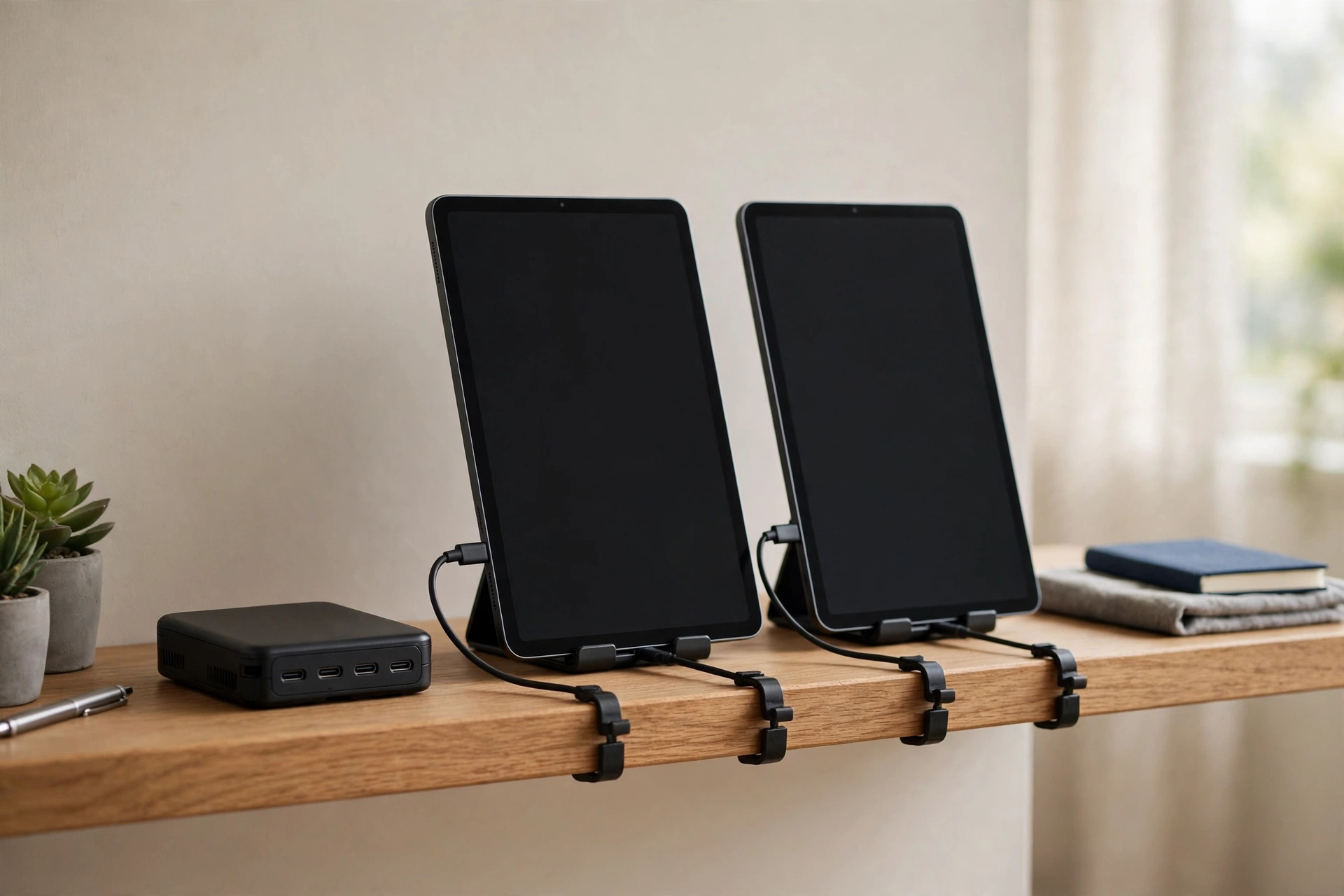
Tablet cable management is the quiet part of the table: one cable per tablet, labeled, and clipped along the back of the desk or the shelf so it never crosses the walkway. Spare cables live in a single labeled bin, not in a drawer full of mystery cords. When every cable has a label and a clip, the charging spot stays tidy, and nobody unplugs the wrong device by mistake.
5 Mistakes That Ruin Tablet Storage
Most tablet trouble comes from five small mistakes. Tablet storage ideas exist to stop all five — and every one of them is easy to avoid.
- Charging every tablet from the same loose cable. One shared cable means one tablet charges and the rest wait, and the cable ends up wherever the last person left it.
- Storing a tablet flat in a drawer for a year. A battery stored empty can fall into a deep discharge and never hold a charge again, and a tablet under a pile gets scratched.
- Leaving the tablet on a hot surface. A sunny windowsill, a radiator, or a laptop vent cooks the battery and shortens its life, even when the tablet is off.
- Stacking tablets on top of each other. Two tablets in one slot slide, scratch, and drop — one slot per tablet, every time.
- Keeping the case, the cable, and the stylus in three different places. A kit that is split up is a kit you will never find whole, and the tablet travels without its charger.
Your Tablet Storage Checklist
Keep this list taped inside the desk drawer. Run through it once a week, and the tablets stay charged until the next check.
- Every tablet has one home — stand, shelf, or drawer slot
- One labeled cable per tablet, clipped and out of the way
- Daily tablet on its stand, plugged in, screen in view
- Kids’ tablet back in its spot, plugged in, every night
- Spare tablet half charged, powered down, in its case
- Case, cable, and stylus together as one kit
- Tablet accessories storage bin labeled, one bin only

FAQs
Where is the best place to store a tablet at home?
Give the tablet you use daily a stand on the desk with its own labeled charger, so it is charged and in view. Keep the kids’ tablet on a low shelf or in a cubby it can reach, and keep a spare tablet in a divided drawer, in its case, half charged. That is tablet storage ideas working the way they should: one home per tablet, one cable per home, no hunting.
How should I store a tablet I am not using for months?
Charge it to around 50%, power it down, and put it in its case in a cool, dry place away from heat and damp. Check it every six months and charge it back to 50% if it has dropped. A tablet stored empty can fall into a deep discharge and never hold a charge again, so half charged is the safe middle.
What is the best tablet stand for a small desk?
Pick a stand that holds the tablet upright at a reading angle, leaves the charging port open, and is heavy enough not to tip when you tap the screen. A folding stand works well on a small desk because it packs flat when the tablet is away, and a stand with a cable slot keeps the charger plugged in while the tablet stands.
How do I stop tablet cables from tangling?
Give every tablet its own labeled cable and clip the cables along the back of the desk or shelf, so they never cross the walkway. Keep spare cables in a single labeled bin, and never toss a loose cable into a drawer with the tablet. That is tablet accessories storage that actually stays tidy: one bin, one label, no mystery cords.
Start With One Charging Spot Tonight
You do not need a new desk or a weekend project. Pick one corner, put a multi-port charger there, label one cable per tablet, and put every tablet back on its spot tonight. That is the system, and it takes ten minutes.
Do the rest the same way, one tablet at a time, and by the end of the week every device will be charged when you reach for it. Next month, you will grab the tablet and find it full, in its spot, and ready to go — and these tablet storage ideas will have done their quiet job, one device at a time.