

Keepsake organization ideas matter the day you open a closet and a box of old baby clothes, ticket stubs, and school drawings tumbles out onto your feet. You meant to sort it years ago. Instead, the box got heavier, another box joined it in the attic, and now the whole collection feels too big and too emotional to touch — so you push it back onto the shelf and close the door.
That is how most keepsakes end up. Nobody plans to fill a closet with boxes they never open. It happens one birthday card at a time, one school project at a time, one “I can’t throw this away, it meant something” at a time. A year of that fills a shelf.
A decade of it fills a room, and the things you saved because they matter are buried under the things you saved because you felt guilty letting them go. Finding the one item you actually want means digging through ten boxes you never look at, and the mess quietly makes the memories harder to enjoy instead of easier. Keepsake organization ideas exist for exactly this moment — when the boxes are full and the memories are buried.
The good news is that sorting keepsakes does not take a weekend of tears or a fancy storage system. Keepsake organization ideas work best when the rule for keeping something is simple, the boxes are few, and every item has a label that says why it mattered. This guide builds exactly that: a story test that makes the hard choices easier, one box per person, the right kind of box, a plan for kids’ artwork, a way to photograph what you cannot keep, and a small yearly habit that stops the pile from growing back. Keepsake organization ideas are not about throwing memories away — they are about keeping the ones that matter where you can actually find them.
Why Keepsakes Pile Up Faster Than Anything Else
Keepsakes pile up faster than anything else in the house because every single one comes with a feeling attached. A chipped mug is easy to toss. A chipped mug your grandmother drank tea from every morning is not a mug at all — it is your grandmother, and throwing it away feels like throwing her away. So it goes in a box, and the next sentimental thing joins it, and the next one, and the box fills with feelings instead of objects.
Guilt does most of the piling. We keep the gift we never liked because someone we love gave it to us. We keep every drawing our kids ever made because tossing one feels like saying their work did not matter. We keep the concert ticket, the baby shoes, the wedding favor, and the dried flowers from a bouquet that fell apart years ago — not because we look at them, but because letting go feels like losing the moment itself. Keepsake organization ideas name that feeling so you can set it aside: guilt is not a reason to keep a box.
There is also the fear that we will regret it later. What if the kids want these drawings when they grow up? What if the family history is in that box? That fear is real, and it is why keepsake organization ideas start with a different question than other kinds of decluttering.
The question is not “do I need this?” — the answer to that is almost always no. The question is “does this carry a story I would miss?” If it does, it stays. If it does not, the memory is safe without the object, and the object can go.
A third reason is that keepsakes never had a home. Clothes go in the closet, dishes go in the kitchen, but keepsakes go in “that box” — and then in another box, and then in a bag in the attic. With no home and no limit, the collection grows without anyone noticing. Keepsake organization ideas fix that first: a small number of boxes, each with a job, each with a label, and nothing else allowed in.
The Story Test: The One Question That Decides Everything
The story test is the heart of this whole system, and it takes about five seconds per item. When you organize family keepsakes, the hardest part is starting — so start with one box, one timer, and the story test. Hold the item, and ask yourself: can I tell the story of this thing in one or two sentences? If you can — “This is the blanket my mom knitted for my daughter the week she was born” — it is a keepsake, and it stays. If you cannot — if the honest answer is “I think someone gave me this” or “I kept it just in case” — it is not carrying a memory, it is carrying guilt, and it can go.
Keepsake organization ideas use the story test because it separates the memory from the object. The memory lives in you, not in the thing. A photo of the item, a note with the story written on it, and the item passed to someone who will use it — that keeps the memory safe and frees the shelf. The Houzz family keepsakes guide makes the same point: if the item has a story attached to it and you are willing to take the time to save the story with it, keep it; if there is no story, let it go.
Work through the boxes one at a time, in short sessions. Set a timer for thirty minutes, pick up one box, and run the story test on everything inside it. Keep a notepad beside you and write the story down for the items you keep — one or two sentences, on a small card or a label, tucked into the box with the item. Future-you will not remember why a chipped mug mattered, but a card that says “Grandma’s morning tea mug, 1987–2009” tells the whole story at a glance. Keepsake organization ideas depend on those little notes more than on any box, because the story is the reason the item is there.
When the thirty minutes are up, stop. Put the keepers back in their box, deal with the rest, and walk away. Sorting keepsakes is emotional work, and tired decisions are bad decisions. Three short sessions beat one long, tearful afternoon, and the boxes will still be there tomorrow.
Gather Everything in One Place First
Before you sort anything, gather it. Go through the house — closets, attic, basement, the top of the wardrobe, the drawer in the hallway — and bring every keepsake box, bag, and loose pile to one spot, like the dining table or a clear patch of floor. This is the step most people skip, and it is the step that makes the whole job honest. Until everything is in one place, you do not know how much you have, and you will keep finding “just one more box” for months.
Seeing it all at once is a shock, and that shock is useful. Three boxes feel like a small collection. Twelve boxes spread across the house feel like a life you have been carrying around. Laying them out together shows you the real size of the job, and it shows you the duplicates too — the three copies of the same school photo, the two identical baby blankets, the stack of birthday cards that all say the same thing. Keepsake organization ideas count on that shock, because it shows you the real size of the job.
Do not sort as you gather. Just collect. Keepsake organization ideas always start with the gather, because you cannot organize what you cannot see. Put everything in the one spot, make a cup of tea, and take a breath. The sorting starts after the gathering, and it starts with the story test, one box at a time.
Sort Into Four Piles: Keep, Photograph, Pass On, Let Go
Once everything is in one place, sort each box into four piles. Keepsake organization ideas use four piles because four choices are enough for any item — more than that, and every item becomes a debate.
- Keep: it passed the story test, and it is one of the best of its kind. These go in the memory boxes.
- Photograph: the memory matters, but the object does not need to live on your shelf. Take a good photo, write the story on the back of the photo or in a note, and let the object go. This pile is bigger than most people expect, and it is where the real space savings happen.
- Pass on: someone else in the family would love this, or it is useful to someone right now. Your sister might want Mom’s recipe cards. A niece might love the baby clothes. Passing an item on keeps its story alive in the family instead of locked in your attic.
- Let go: no story, no one who wants it, no reason to keep it. Donate what is usable, recycle the paper, and let the rest go without a second look. Sentimental clutter is still clutter, and the memory of the moment does not live in a broken souvenir.
Work one box at a time, and finish the box before you open the next one. Keepsake organization ideas finish one box before opening the next, because a half-sorted box is a box you will have to sort twice. When a box is done, the keepers go straight into their memory box, the photograph pile gets photographed that same day, and the pass-on pile goes into a bag by the door to leave the house within the week. Keepsake organization ideas work because the piles leave the table the same day they are made. The faster the piles leave the table, the less chance they have of creeping back into a closet.
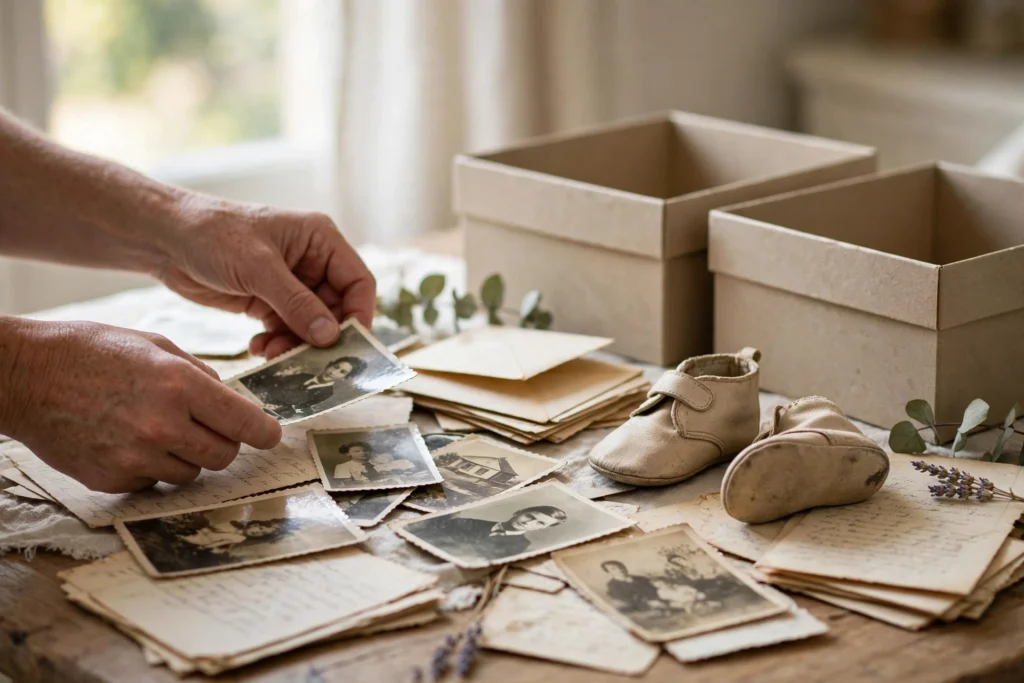
One Box Per Person (or Per Event)
The simplest system that actually lasts is one box per person. One box for you, one for your partner, one for each child — and that is the limit. When a box is full, nothing new goes in until something comes out or gets photographed. The limit is the system. Without a limit, one box becomes two, and two become a shelf, and the shelf becomes a room.
Label the outside of each box with the person’s name and the years it covers, like “Emma — ages 0–5” or “Dad — 1960s–1980s”. Inside the box, use acid-free folders or small bags to separate the kinds of things: school papers in one folder, small clothes in one bag, cards and letters in another. You do not need a complicated filing system inside the box — three or four dividers are plenty, and the goal is that anyone in the family could open the box and find what they are looking for in a minute. Memory box organization is mostly labeling: the label is what turns a box into a story someone can open.
If one box per person does not fit your family, one box per event works the same way: one box for the wedding, one for each big trip, one for each child’s baby year. The rule is the same either way — one box, one label, and a hard limit on how many boxes there are. Keepsake organization ideas stay simple when the limit does the deciding for you.
For kids, a baby keepsake box per child is a gift they will thank you for later. These memory box ideas work for any family, whether you have one child or five. Small kids room organization ideas often treat the closet as the place for toys and clothes, but a single keepsake box on the closet shelf is the part that lasts: the hospital bracelet, the first shoes, the favorite drawing from each school year, the report card that made you proud. When the box is full, sit down with your child and choose together what stays and what gets photographed. It teaches them the same story test you are learning, and it makes the box theirs instead of yours.
Pick the Right Box — and Skip the Expensive Ones
Not every box protects keepsakes. A cardboard box in a damp basement will yellow paper, attract bugs, and fall apart in a few years. A plastic bin with a loose lid lets dust in and keeps moisture trapped. The right box is boring and cheap, and it does two jobs: it keeps light and damp out, and it does not damage what is inside it.
Look for acid-free storage boxes or archival boxes for paper items — photos, letters, schoolwork, and cards. Acid-free materials stop paper from yellowing and keep ink from fading, and they cost little more than a regular box. For clothes and soft items, use clean cotton bags or acid-free tissue paper between folds, and never store clothes in a sealed plastic bag, which traps moisture and invites mildew. Heirloom storage needs the most care of all: for anything fragile — a christening gown, a handmade quilt, a piece of jewelry — wrap it in acid-free tissue and give it its own spot in the box so it does not get crushed.
Keepsake organization ideas do not ask you to buy a whole matching set of fancy boxes on day one. Keepsake storage boxes do not have to be expensive. Budget organization ideas apply here too: start with one good archival box per person, add acid-free folders as you sort, and use what you already have for the rest. A sturdy lidded box you already own, lined with acid-free tissue, beats a pricey decorative box that looks pretty and slowly damages the photos inside it. Spend the money on the acid-free folders and the labels, not on the box itself.
Keep the boxes somewhere dry, cool, and dark — a closet shelf beats an attic or a garage every time. Heat and damp are what ruin keepsakes, and a closet inside the house stays steady all year. Small closet organization ideas cover the same ground: the top shelf of a bedroom closet, with the boxes labeled and facing out, is the best home for keepsakes in most houses.
Kids’ Artwork Without the Mountain
Kids artwork storage is the hardest part of keepsake organization ideas, because it grows every single week and every piece feels like a small masterpiece. A child who brings home two drawings a week makes a hundred drawings a year, and no family has room for a hundred drawings a year for ten years. The answer is not to keep them all, and it is not to throw them all away — it is to keep the best and photograph the rest.
Pick a limit with your child: one folder per school year, and only the pieces that fit in it stay. Let your child choose which ones go in the folder, and photograph the rest before they go. A photo of a drawing keeps the colors, the crooked letters, and the memory of the day it came home, and it takes up no shelf space at all. Photo organization ideas from earlier in this series use the same year-first thinking, and it holds up here too: a folder per year, the best pieces inside, and the rest saved as photos.
For the pieces you keep, date them on the back in pencil — the child’s name, age, and the month — so that in ten years you know which drawing was which. Hang one or two favorites on the fridge or in a frame for a month, then rotate them out and file the next ones. The art that is on display is the art that gets enjoyed, and the art in the folder is the art that gets kept. The rest has already done its job: it made your child proud for a day, and a photo keeps that day safe.
A simple trick for the end of the school year: lay all the year’s artwork out on the floor, pick the five best together, photograph the rest, and file the five. Five pieces a year, ten years of school, fifty pieces in one box — a collection you can actually look through, instead of a mountain you avoid.
Photograph What You Cannot Keep
Photographing a keepsake is not a second-best option. Photo keepsakes are the easiest to save, and when you digitize keepsakes the photo becomes the keepsake itself: one you can look at, share, and back up. For a lot of items, it is the best option, because a photo can be looked at, shared, and backed up, while the object sits in a dark box for twenty years. A photo of your child’s first pair of shoes, taken in good light with the story written underneath, is a keepsake you will actually open. The shoes in a box are a keepsake you will forget you have.
Set up a small photo station when you sort: a plain background, like a white sheet on a table, and daylight from a window. Keepsake organization ideas use a photo station like this because good light makes the photo worth keeping. Lay the item flat, take two or three shots from different angles, and then write the story in a note on your phone or on a card: what it is, whose it was, and why it mattered. Digital file organization ideas cover what happens next — the photos go into a folder named for the person or the year, backed up in the cloud, so the memory is safe even if the phone is lost.
Keepsake organization ideas treat the big things the same way. The chair that will not fit in your house, the box of trophies from a sport you no longer play, the collection of souvenir mugs from every trip — photograph them, write the story, and let the objects go to someone who will use them. The memory does not shrink when the object leaves. If anything, it gets bigger, because now you can actually see it.
Label Everything So Future-You Knows Why It Mattered
A box of unlabeled keepsakes is a mystery box, and mystery boxes get ignored. Labeling is the difference between a collection you enjoy and a collection you avoid, and it takes less time than the sorting did.
Keepsake box labels go on the outside of every box: whose it is, what years it covers, and what is inside in three or four words. Label the folders inside the box the same way. And for the items that need it, add a small card with the story — one or two sentences, the date, and the name of the person it belonged to. Use a pencil or an acid-free pen for paper items, and never use sticky notes on photos, because the glue damages them over time.
A neat trick from professional organizers is twin-check labeling: write the same number on the item and on its story card, so the story and the object can live in different places and still find each other. The number on the baby shoes matches the number on the card that says “Emma’s first shoes, worn home from the hospital, March 2021.” It sounds fussy, but it is the system that keeps a box organized ten years from now, when you no longer remember which shoes were which.
Labeling is also what makes the boxes shareable. When your kids grow up and ask about their childhood, a labeled box is a story they can open and read. An unlabeled box is a chore they will put off, and one day it may end up in the trash because nobody knew what was in it. Keepsake organization ideas are really about the next generation: you are not just sorting your things, you are writing the labels that let your family find the stories later.
Display a Few, Store the Rest
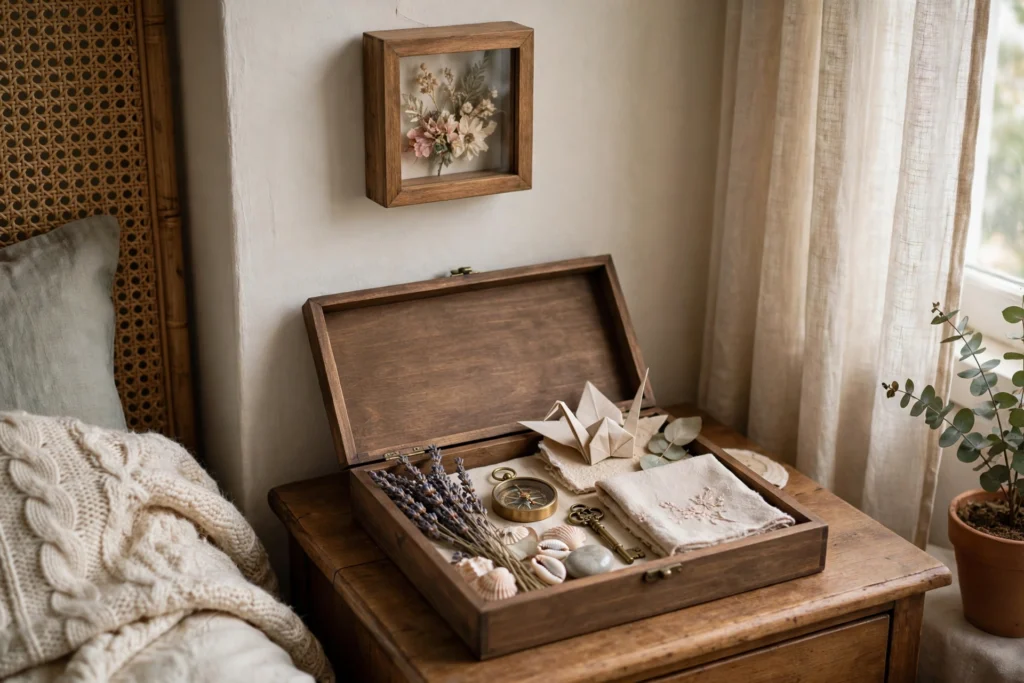
Not every keepsake belongs in a box. The ones you love most deserve to be seen, and displaying a few is what makes the rest of the system feel worth it. Pick three to five items per room — a framed letter, a shadow box with a baby outfit and a photo, a small shelf with two or three special objects — and give them a real place in the house.
A shadow box display is the best way to show the keepsakes you love most. A deep frame holds a ticket stub, a small toy, a dried flower, and a photo together, and it keeps the dust off while letting you see all of it. Hang one in the hallway or the living room, and it becomes a conversation piece instead of a box in the closet. Rotate what is on display once or twice a year, so the things in the boxes get their turn in the light.
The display rule is simple: if you love it enough to look at it every day, it earns a spot on the wall or the shelf. If you love it but you never look at it, it earns a spot in the box with a label. Both are honored, and neither is buried. Keepsake organization ideas work when the best pieces are visible and the rest are findable, not when everything is hidden or everything is out.
Holiday Keepsakes: A Small Yearly Ritual
The holidays are when most keepsakes arrive — the ornament a child made at school, the card from a relative, the photo from the family dinner, the small gift that meant more than the big ones. Without a plan, December adds a whole new box to the pile every year. With a small ritual, it adds five or six items to the right boxes, and nothing else.
Keepsake organization ideas for the holidays are really a January habit, not a December project. Here is the ritual: in the first week of January, once the decorations are down, spend twenty minutes with the holiday keepsakes. Pick the one or two items from the year that carry a real story, label them with the year, and file them in the right person’s box. Photograph the rest — the cards, the kids’ crafts, the table decorations — and let the paper ones go. The ornaments go back in their own box, not in the keepsake box, because ornaments have a home already.
Keepsake organization ideas include a yearly check: this is also the moment to check the boxes themselves. Open each one, look at the labels, and make sure nothing damp or dusty has crept in. It takes five minutes per box, once a year, and it is the habit that keeps a collection safe for decades. A weekly cleaning schedule keeps the house tidy week to week, and this yearly check keeps the keepsakes safe year to year — the same idea, on a longer clock.
If your family has holiday traditions — the same ornament hung every year, the same stocking, the same recipe card used every December — those are the keepsakes that matter most, and keepsake organization ideas give them a label with the year they started. A tradition with a date on it is a family story, and the box that holds it is the one your kids will open first when they grow up.
What to Keep, Photograph, or Let Go
| Item type | Keep it if… | How to store it |
|---|---|---|
| Baby clothes and first shoes | It has a clear story and it is the best one of its kind | Acid-free tissue, one per child, in their box |
| Kids’ artwork | It is one of the year’s best five | Dated on the back, in a folder per school year |
| Letters and cards | The words matter, not just the sender | Acid-free folders, upright, in the person’s box |
| Photos and negatives | They are the only copy or the best print | Acid-free sleeves, by year, backed up digitally |
| Tickets, programs, stubs | They mark a moment you still talk about | Photograph and file, or keep in a small envelope |
| Heirlooms and jewelry | They carry a family story and someone will wear or use them | Wrapped in tissue, in a small box, labeled |
| Gifts you never liked | Someone else would love or use it | Pass it on — a gift’s job is to be enjoyed |
| Broken souvenirs and duplicates | There is a better copy or a photo already | Photograph it, then let it go |
Keepsake organization ideas look strict in a table, but the table is really a kindness. Every item that passes the test gets a safe home and a label. Every item that does not pass gets a photo and a story, and then it leaves — and the shelf it leaves behind is space for the keepsakes that are still to come.
The One-Hour Weekend Plan
Keepsake organization ideas come together fastest in one focused hour. Not a whole weekend, not a perfect system — one hour, with a timer, in this order.
- Minutes 0–10: gather. Bring every keepsake box, bag, and loose pile to one spot. Do not sort yet — just collect, and see how much there really is.
- Minutes 10–35: sort one box. Run the story test on everything in the first box. Keepers go in the memory box, photograph pile gets photographed, pass-on pile goes in a bag by the door, and the rest goes in the trash or recycling.
- Minutes 35–50: label and file. Label the memory box with the name and years, add story cards to the keepers, and put the box on its shelf.
- Minutes 50–60: photograph the pile. Take clear photos of the photograph pile, write the stories in a note, and file the photos in a folder named for the person or the year.
One hour is enough to finish one box completely, and one finished box is the proof the system works. Keepsake organization ideas come together in that hour because the system is simple on purpose. The rest of the boxes take an hour each, spread across the next few weekends, and each one gets easier because you already know the questions. Small home office organization ideas follow the same pattern — one drawer, one hour, one finished job — and keepsakes are no different, even though they feel heavier.
Keep It Tidy With One In, One Out
A keepsake system only stays tidy if new items have a rule, and the rule is one in one out: when a new keepsake arrives — a drawing, a card, a souvenir — it goes in the box only if something else comes out, gets photographed, or gets passed on. Keepsake organization ideas stay tidy with that one rule, because the box stays the same size forever, and the collection stays the best of what you have instead of all of what you have.
Keep a small tray or a folder by the door for new keepsakes as they come in, and sort it once a month. Ten minutes, once a month, is the whole maintenance job: story test the new items, file the keepers, photograph the rest, and put the tray back empty. A weekly cleaning schedule handles the rest of the house, and this monthly ten minutes handles the keepsakes — the same habit, on a smaller clock, for the things that matter most.
And once a year, in January, do the holiday check from above: open each box, check the labels, and make sure the collection still earns its shelf. If a box is full, that is the system working, not failing — a full box means you kept only the best, and the next item in will be chosen with the same care as the ones already there.
Frequently Asked Questions
How do I organize sentimental keepsakes without throwing away memories?
Keepsake organization ideas start with the story test: keep an item only if you can tell its story in one or two sentences. The memory lives in you, not in the object, so photograph the items you cannot keep, write the story on a card or in a note, and let the object go. One box per person, with labels and story cards inside, keeps the memories you kept where you can actually find and enjoy them.
What is the best way to store keepsakes long term?
Keepsake organization ideas store things long term in acid-free boxes or folders, kept somewhere dry, cool, and dark — a closet shelf inside the house beats an attic or a garage. Wrap clothes in acid-free tissue, store paper upright in acid-free folders, and label every box with the person’s name and the years it covers. Check the boxes once a year for damp or dust, and keep a digital backup of the photos and stories.
How do I organize my kids’ artwork?
Keepsake organization ideas for kids’ artwork use a simple limit: one folder per school year, and only the best pieces stay in it. Let your child choose which ones go in the folder, photograph the rest before they go, and date the keepers on the back in pencil. Pick the five best pieces at the end of each school year, hang one or two favorites on display for a month, and file the rest — fifty pieces in ten years is a collection you can look through, not a mountain you avoid.
How many keepsake boxes should I have?
Keepsake organization ideas work best with one box per person — one for you, one for your partner, one for each child — and that is the limit. When a box is full, nothing new goes in until something comes out, gets photographed, or gets passed on. The limit is the system: without it, one box becomes two, and two become a shelf. One box per event works the same way if that fits your family better.
Memories You Can Actually Find
Keepsake organization ideas are not about a perfect closet or an expensive set of boxes — they are about a story test you can run in five seconds, one box per person, labels that tell future-you why an item mattered, and a photo for everything you cannot keep. Pick the box that bothers you most, spend one hour on it this weekend, and let keepsake organization ideas carry you through the rest.
Start with the gathering, because keepsake organization ideas begin with seeing it all in one place — the step that makes the job honest. Then sort one box, label it, and put it back on its shelf. The rest of the work takes care of itself — and the next time you open that closet, you will find the blanket your mom knitted, the shoes your daughter wore home, and the drawing that made you laugh, all in one place, all with their stories attached. Keepsake organization ideas pay off most on the day your kids open those boxes and find their childhood waiting for them, labeled, safe, and ready to share.