

These nursery organization ideas will turn a small nursery into a calm, easy room where everything you need is right where you reach for it.
A new baby brings a mountain of stuff into a small room — diapers, clothes in three sizes, blankets, bottles, books, and toys that seem to multiply overnight. Without a plan, the nursery turns into a pile of laundry and half-open boxes within a week, and every diaper change becomes a hunt through drawers. That is not a failure on your part. It just means the room needs zones that match how you actually use it.
The good news is that a small nursery is easier to organize than a big one, because every item has to earn its spot. With a few baskets, some labels, and a clear spot for each daily job, you can set the room up in one afternoon. These nursery organization ideas walk you through each zone, from the changing table to the closet, so the room works on the very first night home.
1. Start With Zones, Not Storage Bins
Before you buy a single basket, split the room into four zones: sleep, change, feed, and dress. The crib is the sleep zone. The diaper changing station is the change zone. A chair with a small table is the feed zone. The baby dresser and nursery closet are the dress zone.
When each job has its own corner, you stop carrying things back and forth across the room at 3 a.m. Choose nursery furniture that does more than one job — a dresser that doubles as a changing table, for example — and the zones stay simple.
Walk through a normal day in your head and place things where the job happens. Diapers, wipes, and cream live at the changing station, not in a drawer across the room. Burp cloths live by the chair, not in the closet. This is one of the simplest nursery organization ideas, and it is the one that saves the most time: store things where you use them.
- Keep a small basket of baby essentials on the changing table: diapers, wipes, cream, and a spare onesie. You should never have to leave a baby on the table to fetch something.
- Put a soft night-light near the changing station so you can see without waking the baby fully.
- Leave one clear surface in each zone. A full surface is not storage — it is a landing spot you will need tonight.

2. Set Up a Diaper Changing Station That Restocks Itself
A good diaper changing station holds a full day of supplies within arm’s reach. Use a diaper caddy with divided sections so diapers stand upright in one slot, wipes sit flat in the next, and cream and a thermometer share the last slot. When you can see everything at a glance, you know what is running low before it runs out.
Keep a backup stash in the closet or on a nursery shelf, and refill the caddy each evening when you do the last change of the day. That two-minute refill is the whole trick. A station that is always full means no midnight scrambling, and it is one of those nursery organization ideas that pays off every single night.
Baby laundry piles up fast, so keep a small lidded hamper right beside the changing station for soiled clothes and cloths. Empty it daily and the room stays fresh. A hamper that sits across the room gets ignored, and the pile ends up on the floor instead.
3. Make Baby Clothes Storage Grow With Your Baby
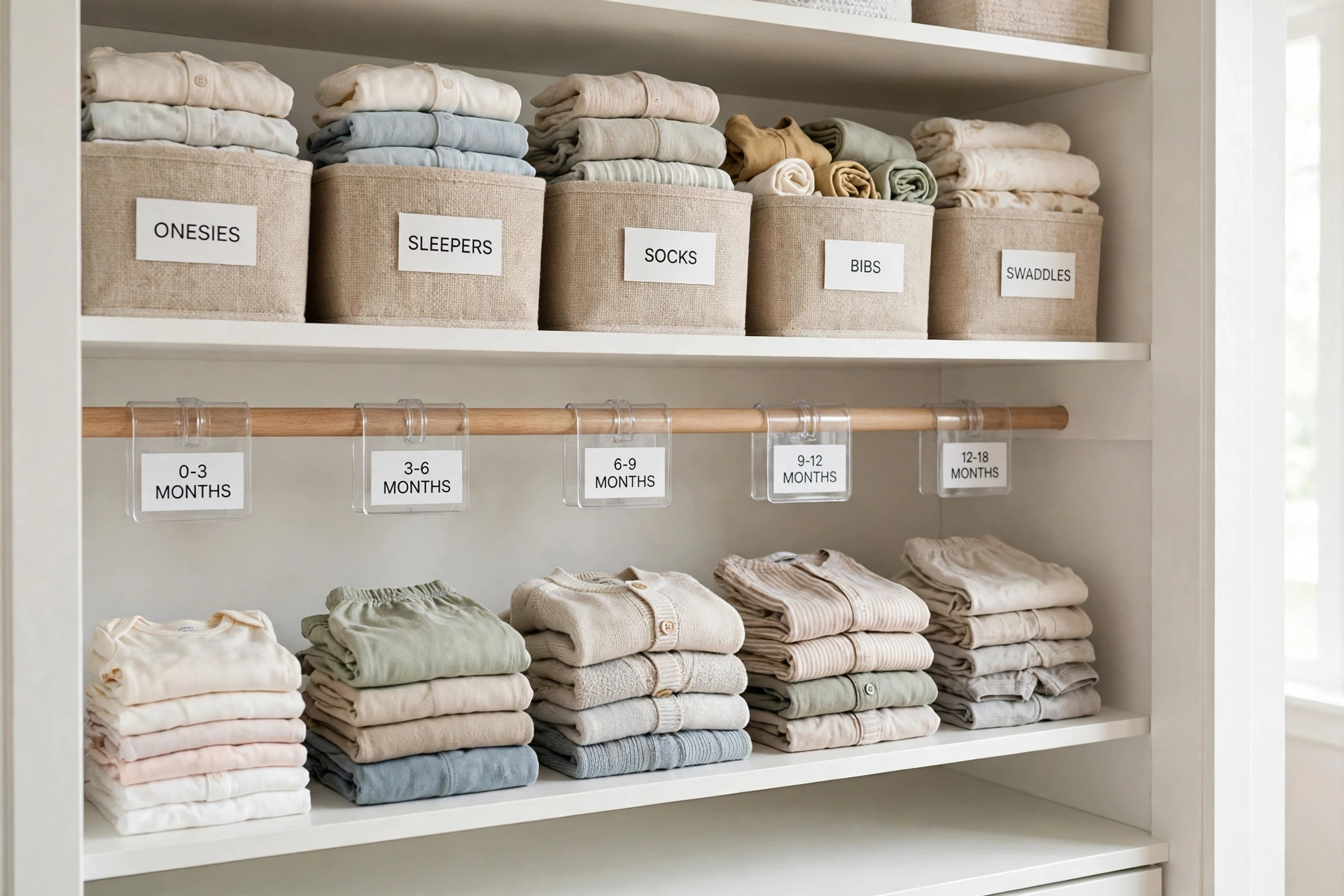
Baby clothes storage works best when you sort by size first and by type second. Babies outgrow clothes in weeks, so keep only the current size in the baby dresser and the nursery closet. Store the next size up in a labeled bin on the top shelf, and pack outgrown clothes into a bin marked with the size and the month. This way the dresser never holds clothes that no longer fit.
Closet dividers are the cheapest fix in the whole nursery. Hang simple size dividers on the closet rod — newborn, 0–3, 3–6, 6–9 — and hang clothes in order. When a size stops fitting, slide those clothes out and move the next divider forward. It takes five minutes and stops the daily guessing about what still fits. Sorting by size first is one of those nursery organization ideas that keeps the dresser honest: if it does not fit this week, it does not live in the drawer.
Fold baby clothes in small stacks or roll them in drawer dividers so you can see everything from above. A drawer full of flat stacks hides the bottom half, and you end up buying clothes you already own. Rolled clothes also make the small nursery dresser hold far more than you would expect.
4. Use the Nursery Closet for More Than Clothes
The nursery closet is the biggest storage space in the room, so treat it like a mini stockroom. Hang the current clothes on the rod, then use the floor and the top shelf for the rest. A low shelf or a couple of nursery storage baskets on the floor can hold the diaper stash, extra blankets, and the baby bath supplies. The top shelf holds the next-size clothes bin and the keepsake box.
If the closet has a single high shelf, add a second shelf or a hanging organizer with pockets. Hanging shelves turn one rod into six small cubbies for shoes, hats, socks, and bibs — all the small things that vanish in a deep drawer. Using the closet’s empty air is one of the smartest nursery organization ideas for a small nursery, and it costs far less than new furniture.
| Closet storage option | Best for | Watch out for |
|---|---|---|
| Hanging pocket organizer | Shoes, hats, socks, bibs | Pockets sag if overloaded |
| Second shelf | Next-size clothes, keepsakes | Needs a step stool to reach |
| Floor baskets | Diaper stash, blankets, bath supplies | Can block the door if too wide |
| Labeled bins on top shelf | Outgrown clothes, gift clothes | Label both sides or you will forget |
Keep one bin in the closet for outgrown clothes and one for gifts you have not opened yet. Label both clearly. When family visits with more clothes than your baby can wear this month, the gift bin keeps them safe and sorted until the right size comes around.
5. Put Nursery Shelves and Baskets Where You Can Reach Them
Nursery shelves should hold the things you grab every day at arm height and the things you rarely need up high. The middle shelf holds baby books, the sound machine, and the diaper caddy refill. The top shelf holds the extra blankets and the next-size bin. Nothing you need at 2 a.m. should live above your head.
Nursery storage baskets are the workhorses of a small nursery. One basket holds clean burp cloths by the chair, one holds the baby’s daily toys, and one holds the spare sheets near the crib. Choose baskets with handles so you can carry the whole basket to the laundry or to the living room without making three trips. Baskets with handles are the heart of most nursery organization ideas for small rooms, because the whole basket moves with you.
Label your bins even if the system seems obvious now. In three months, when you are tired and the baby has moved to a new size, a clear label is the difference between a five-second grab and a ten-minute search. A label maker is nice, but masking tape and a marker work just as well.
6. Plan Toy Storage Before the Toys Take Over
Toy storage starts small and grows fast, so set the rule early: every toy lives in one basket or on one shelf, and the basket has a limit. It is one of the easiest nursery organization ideas to keep, and it works at every age. When the basket is full, something leaves before anything new comes in. This one habit keeps a small nursery from filling up with toys your baby cannot even reach yet.
For now, your baby needs very little: a few soft toys, a play mat, and two or three board books. Keep those in one low basket near the crib so you can grab one during a fussy moment. Rotate the toys every week or two — put half away and bring out the other half — and the old toys feel new again. Rotating toys is one of my favorite nursery organization ideas because it costs nothing and it works at every age.
As your baby grows into a toddler, the same basket rule still works. That is also when ideas from small kids room organization ideas start to fit your room — the same zones and bins, just sized up for a bigger child with more toys and more opinions.
7. Keep Baby Books and Bedtime Gear Together
Baby books belong near the chair where you read them, not across the room. A small basket or a low forward-facing shelf by the glider holds five or six books at a time. When the shelf holds only a few, your baby can actually see the covers and pick one. Keeping baby books near the chair is one of the simplest nursery organization ideas, and it works because the books are where the reading happens.
Build a bedtime basket that lives by the crib: a sleep sack, a pacifier, a small night-light, and the sound machine remote. Everything for the last ten minutes of the day sits in one spot, so bedtime follows the same path every night. Babies love routine, and a bedtime basket makes the routine easy to repeat even when you are exhausted.
If your nursery shares space with a bigger child’s room later, the same system scales. Ideas from fall kids room organization ideas and holiday kids room organization ideas use the same basket-and-label habits for older kids — start simple now, and the room grows with your family.
8. A One-Afternoon Nursery Setup Checklist
You can set up the whole nursery in one afternoon if you work zone by zone, and these nursery organization ideas fit into that one afternoon. Put the baby down for a nap, set a timer, and follow these steps.
- Clear every surface, then mark the four zones: sleep, change, feed, dress.
- Put the diaper caddy on the changing table and fill it for a full day.
- Sort baby clothes by size; keep only the current size in the dresser and closet.
- Hang closet dividers and move the next size up to a labeled bin on the top shelf.
- Place nursery storage baskets: burp cloths by the chair, toys near the crib, sheets by the crib.
- Set up the nursery shelves: daily items at arm height, extras up high.
- Put the baby laundry hamper beside the changing station and the bedtime basket by the crib.
- Label every bin, then walk the room once and check that nothing you need at night is out of reach.
When the zones are set, the changing table is stocked, and the closet holds only clothes that fit, you are done. The room will not stay perfect — babies see to that — but with a system like this, a five-minute tidy at the end of the day brings it right back. That is the real test of nursery organization ideas that work. And if you ever need extra space, under bed storage ideas in the next room can hold the out-of-season clothes and the keepsake bin without crowding the nursery.
Frequently Asked Questions
What do I need most in a small nursery?
You need four zones and very little else: a safe crib, a stocked diaper changing station, a comfortable chair, and a dresser or closet for the current size of clothes. Start there and add storage only when a real need shows up. Most nursery organization ideas fail when parents buy bins before they know what goes in them.
How do I organize a nursery closet with no built-in storage?
Add a second shelf or a hanging pocket organizer, use closet dividers on the rod, and keep labeled bins on the floor for diapers and outgrown clothes. A small nursery closet holds a surprising amount once the dead air above the rod is used.
How many baby clothes should I keep out at once?
Keep one week of the current size in the dresser — about seven to ten outfits — and store the rest. Babies outgrow sizes fast, and a dresser that holds only what fits makes mornings much easier.
Where should I store outgrown baby clothes?
Pack them into a labeled bin by size in the closet or in under bed storage ideas boxes in another room, with the size and month written on the outside. Keep one small keepsake bin per size for favorites, and pass the rest along. That same labeling habit is behind most nursery organization ideas for small rooms. Seasonal clothing storage ideas work the same way for older kids’ out-of-season clothes.
Conclusion
A nursery does not need to be big to work well, and the best nursery organization ideas are the simple ones. It needs a stocked changing station, clothes that fit, baskets you can actually reach, and labels that make sense when you are half asleep. Set up the four zones once, refill the caddy each night, and let the room grow with your baby. The calm you feel walking into a tidy nursery at midnight is worth every bit of the one afternoon it took to set it up.