
Winter closet organization ideas start with one honest question: can you find your warmest coat, your gloves, and your boots in under a minute on a freezing morning? If the answer is no, your closet is not failing you — it is just set up for summer, and winter needs a different plan.
Bulky coats, thick sweaters, boots, scarves, and hats take up far more room than t-shirts and sandals, so the same layout that worked in July will feel packed by December. The good news is that you do not need a bigger closet or a full weekend to fix it. With a few smart swaps, your winter closet organization ideas can turn a crowded closet into a calm, easy morning routine.
Start with a quick closet declutter
Before you buy a single bin, take everything out of one section at a time. A full closet declutter sounds big, but doing it in sections keeps it doable.
Pull out the coats first, then sweaters, then boots and winter accessories. Ask three questions about each item: did I wear it last winter, does it still fit and keep me warm, and do I actually like it? If the answer is no to two of those, it goes in a donate bag. You will be surprised how much space appears once the too-tight coat and the scratchy sweater you never reach for are gone.
This is also the right moment for a seasonal closet swap. Move light jackets, linen pieces, and summer shoes to a high shelf or a bin on top of the closet. You do not have to store them far away — just out of the daily path. What stays should be only your cold-weather clothing: the coats you wear weekly, the sweaters you love, and the boots that handle snow and slush. If you tried our small closet organization ideas before, the same rule applies here: daily items at eye level, rarely used items up high.
Winter coat storage that actually holds up
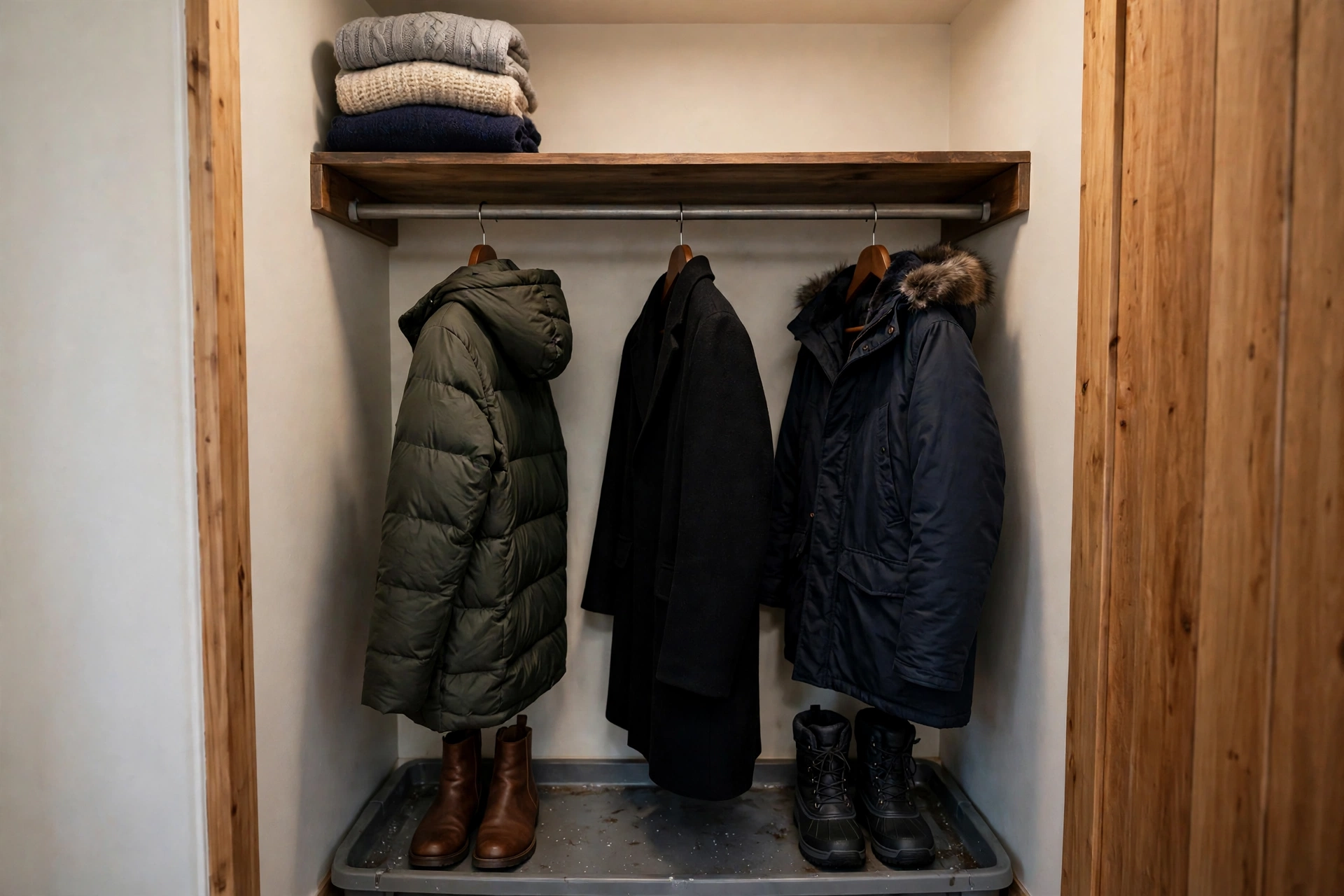
Coats are the bulkiest thing in a winter closet, so good winter closet organization ideas put winter coat storage first. Use strong, wide hangers — thin wire hangers bend under a wool coat and leave dents in the shoulders. Give each coat a little breathing room instead of packing them shoulder to shoulder. If coats are squeezed tight, you cannot see what you own, and you will grab the same one every day out of habit.
For winter closet organization ideas in a small closet, try this order from left to right: the coat you wear most days, then a dressier coat, then rain or snow gear. Hang a small hook on the inside of the closet door for the coat you wore yesterday so it airs out before going back in. Kids’ coats do better on low hooks they can reach themselves — mornings go faster when little hands can grab their own coat without help. And if your entryway is doing double duty, a few sturdy hooks by the door can hold the two most-used coats and free up real closet space, which is a simple win for entryway organization.
Sweater storage without the stretch
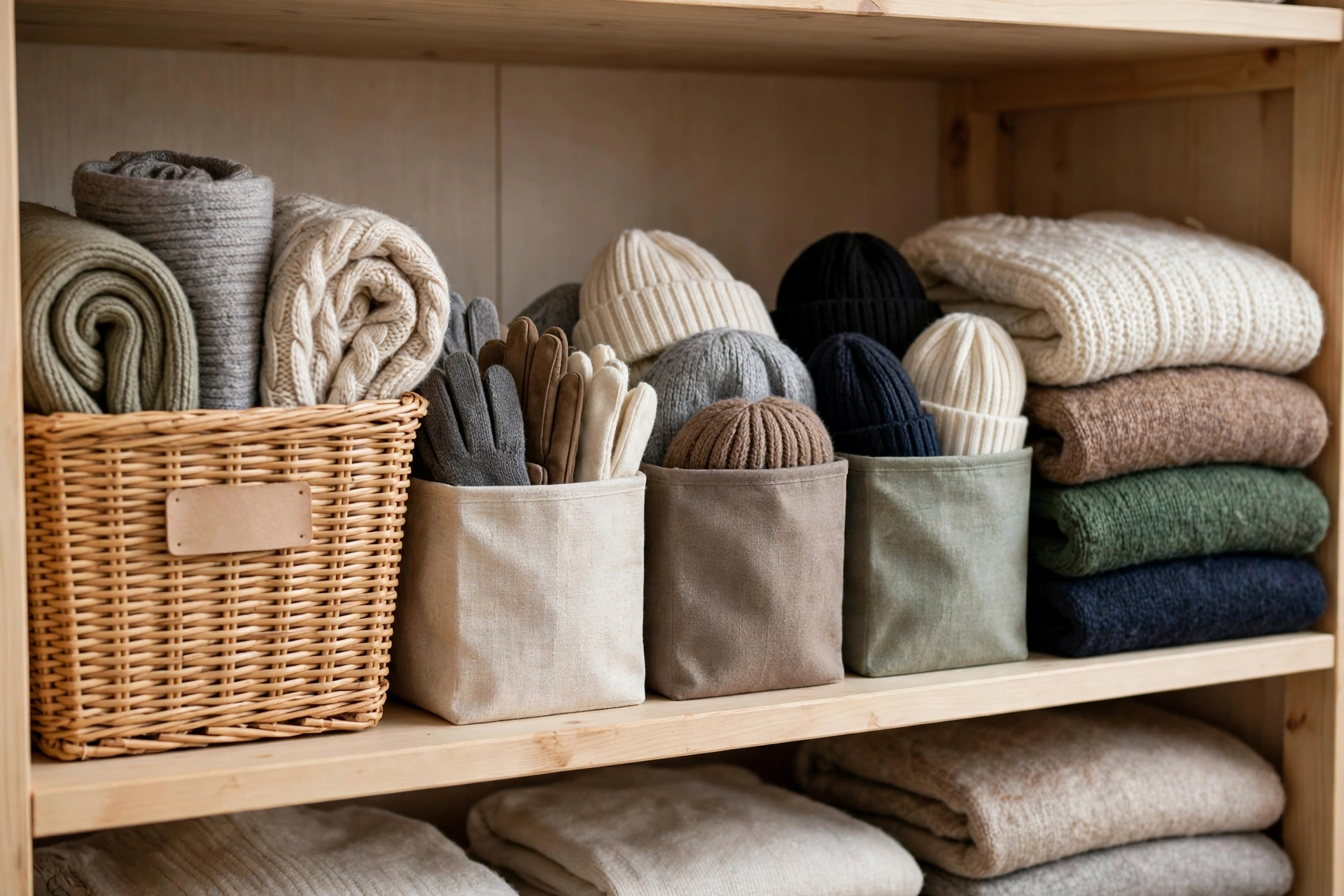
Sweaters hate hangers, and the best winter closet organization ideas treat them gently. Hanging a heavy knit pulls it out of shape, so sweater storage works best folded. Stack sweaters in piles of three or four — any higher and the bottom one gets buried. Roll thinner knits if shelf space is tight; rolling also makes it easier to see colors at a glance. Put your favorite two or three sweaters at the front of the shelf and the rest behind them.
A quick tip that saves sweaters: fold them right after laundry instead of leaving them in a chair pile. That chair pile is where wrinkles and missing pairs start. If moths are a worry in your home, a cedar block or lavender sachet on the shelf is a gentle, low-cost fix. Keep one small bin for hand-wash-only knits so they do not end up in the regular wash by mistake.
Boot storage that handles snow and mud
Boot storage is where most winter closet organization ideas fall apart, because boots are tall, heavy, and often wet. A boot tray by the closet floor (or just outside it) catches melting snow and keeps the closet floor clean. Line boots up in pairs, toes facing out, so you can grab a pair without digging. Tall boots stay upright better with a rolled magazine or a pool noodle inside — a cheap trick that stops them flopping over onto everything else.
Keep only two or three pairs in the main closet: everyday boots, snow boots, and one dressier pair. Store the rest — hiking boots, extra rain boots — in a bin on a high shelf or in another room. Wet boots should dry near the door, not inside a closed closet, so they do not leave damp smells behind. Wipe the tray once a week and the whole setup stays fresh all season.
Scarf storage, glove storage, and small winter accessories
Scarves, gloves, and hats are small, but in winter closet organization ideas they cause the most morning chaos. Scarf storage works best when you can see each scarf: hang them on shower-curtain rings on one hanger, or fold them into one open basket. Glove storage is simpler than people make it: one basket, one rule — gloves go back in pairs, right after you come inside. Clip kids’ gloves together with a small clip so the single-glove hunt ends for good.
Keep all your winter accessories in one zone of the closet, not scattered across three shelves. One basket for scarves, one for hats and gloves, and one small tray for extras like hand warmers and lip balm. When everything small lives together, you stop buying a third pair of gloves because you could not find the first two. Our holiday closet organization ideas post uses the same one-zone trick for guest closets, and it works just as well for your everyday winter setup.
A winter closet layout that fits a small closet
You do not need a walk-in closet to make winter closet organization ideas work. A small closet just needs clear zones: coats on the rod, sweaters on one shelf, boots on the floor, and accessories in baskets. Use the door: an over-the-door hook holds tomorrow’s outfit or a scarf you wear daily. Use the top shelf for out-of-season bins, and keep a small step stool nearby if reaching it is a stretch.
Here is a simple layout you can copy:
| Closet zone | What goes there | Why it works |
| Rod, left side | Everyday coat + one dress coat | Fastest grab on cold mornings |
| Rod, right side | Snow gear and rain coats | Kept apart from daily coats |
| Middle shelf | Folded sweaters, 3–4 per stack | No stretching, easy to see |
| Top shelf | Out-of-season bin | Out of the daily path |
| Floor / tray | 2–3 pairs of boots | Catches snow and mud |
| Basket zone | Scarves, hats, gloves | Small items stop going missing |
If you share a closet, give each person one section of the rod and one basket. Shared closets get messy when zones blur, and a simple split keeps the peace without a big talk about it.
The 10-minute weekly reset
Even a tidy closet drifts by February, which is why winter closet organization ideas need a reset routine. Coats pile up, a scarf ends up on the floor, and boots wander. A 10-minute weekly reset fixes it before it becomes a weekend job.
Pick a day — Sunday night works well — and do four things: hang up any coats left on chairs, pair up gloves and scarves, line up boots, and pull out anything that no longer fits the season. That is it. No deep clean, no rethinking the whole system.
Pair the reset with your winter pantry organization ideas routine if you like batching chores: while soup simmers, reset the closet. And if holiday guests are coming, this same reset doubles as prep — check our holiday cleaning schedule post for a room-by-room plan that fits around it.
Common winter closet mistakes to skip
- Hanging heavy sweaters, which stretches them out of shape
- Packing coats so tight you cannot see or reach them
- Storing wet boots inside a closed closet
- Keeping every coat you have ever owned “just in case”
- Buying bins before decluttering — you may not need them
- Putting small accessories in five different spots
Avoid those six, and these winter closet organization ideas will keep your closet calmer with far less effort than you expect.
FAQ
How many winter coats should I keep in my closet? Two to four is plenty for most people: one everyday coat, one dressier coat, and snow or rain gear if your weather needs it. More than that usually means some coats never get worn — donate or store the extras.
What is the best way to store sweaters in winter? Fold them in stacks of three or four on a shelf. Hanging heavy knits stretches them, and deep piles hide the bottom sweater. Roll thin knits if shelf space is tight.
How do I keep a small closet organized in winter? Use zones: coats on the rod, sweaters folded on a shelf, boots in a tray on the floor, and scarves, hats, and gloves in baskets. Move out-of-season clothes to a high shelf so daily items stay at eye level.
How often should I declutter my winter closet? Do a quick check at the start of winter and a 10-minute reset each week. A full declutter once a season is enough if the weekly reset keeps things in check.
A calmer closet, a calmer morning
Winter mornings are hard enough without a closet fight, and winter closet organization ideas are meant to remove that fight. Start with the declutter, give coats strong hangers, fold your sweaters, tray your boots, and basket your scarves and gloves.
Small changes, done once, pay off every single morning until spring. Pick one zone tonight — the coat rod is a great start — and see how much easier tomorrow feels with winter closet organization ideas in place. Want more ideas? Our small closet organization ideas guide is a good next read if your closet is tight on space year-round.