
Trophy Storage Ideas That Keep Every Trophy Safe
Trophy storage ideas become urgent the day the shelf runs out of room and a new trophy lands on the kitchen counter. You know the pile by now: a soccer trophy leaning against a bookshelf, a spelling bee cup balanced on top of the printer, and a dusty medal-winner’s cup hiding behind the plant. Each one meant something the day it was won. Now they are just in the way, and nobody can find the one they actually want to show off.
The problem is not that your family wins too much. The problem is that the trophies never got a real home. A trophy is awkward to store: it is tall, top-heavy, easy to knock over, and hard to stack. That awkward shape is exactly why trophy storage ideas start with sorting, not shopping, instead of starting with a bigger box.
Toss a few into a box and the gold cups scratch each other, the little figures snap off, and the engraved plates get hidden under a pile of ribbons. Leave them all out and the room starts to look like a shop window instead of a place to live.
Good trophy storage ideas fix this by splitting the collection into two groups: the ones worth showing and the ones worth keeping safe. The best trophies get a spot where people can see them. The rest go into a box that protects them and still lets you find any single one in under a minute. Nothing gets thrown away in a rush, and nothing gets broken in a crowded box.
This guide walks through the whole setup: how to sort the collection before you buy a single shelf, the display options that work in a real home, the boxes that keep stored trophies safe, a simple routine for kids’ trophies that keeps growing, and the cleaning habits that keep gold from going dull. Set it up once, and these trophy storage ideas will turn the trophy pile into a system that actually shows off the wins.
Sort the Collection Before You Buy Anything
Every storage project fails when it starts with shopping. Do not buy a shelf or a case until you know what you own. Pull every trophy out of every room, every closet, and every box, and put them all on one table.
You will be surprised at how many there are. Most families find trophies they forgot they had, including duplicates from the same season and a few that nobody remembers winning. That first pile on the table is where honest trophy storage ideas begin, because you cannot store what you have not counted.
Now sort them into three piles. Pile one is the display group: the trophies that still make someone smile when they see them. Pile two is the keep group: trophies worth saving but not worth a shelf spot right now. Pile three is the let-go group: broken trophies, duplicates, and the ones nobody claims. The let-go pile does not have to leave the house today, but it does not get a shelf either.
A simple rule keeps the sorting honest: if a trophy has a name, a date, and a memory attached to it, it stays. If nobody can say what it was for, it goes in the keep box or the let-go pile. This is the same habit that makes medal storage ideas work, because medals and trophies both pile up for the same reason — nobody ever stops to sort them.
Count the display pile when you finish. That number decides everything else. Five trophies need one shelf. Fifteen need a wall. Thirty need a case plus a box.
Write the number down before you shop, so you buy storage that fits the collection you have, not the one you imagine. That count is the backbone of any trophy storage ideas plan, because the plan only works when it fits the trophies you actually own.
Pick One Display Spot and Stick to It
Trophies look best when they live in one place. Spread them across five rooms and each one looks like clutter. Group them in one spot and they look like a collection. Pick the room where the family actually spends time: the living room, the home office, or the kids’ room. Then pick one wall or one shelf unit inside that room and call it the trophy spot.
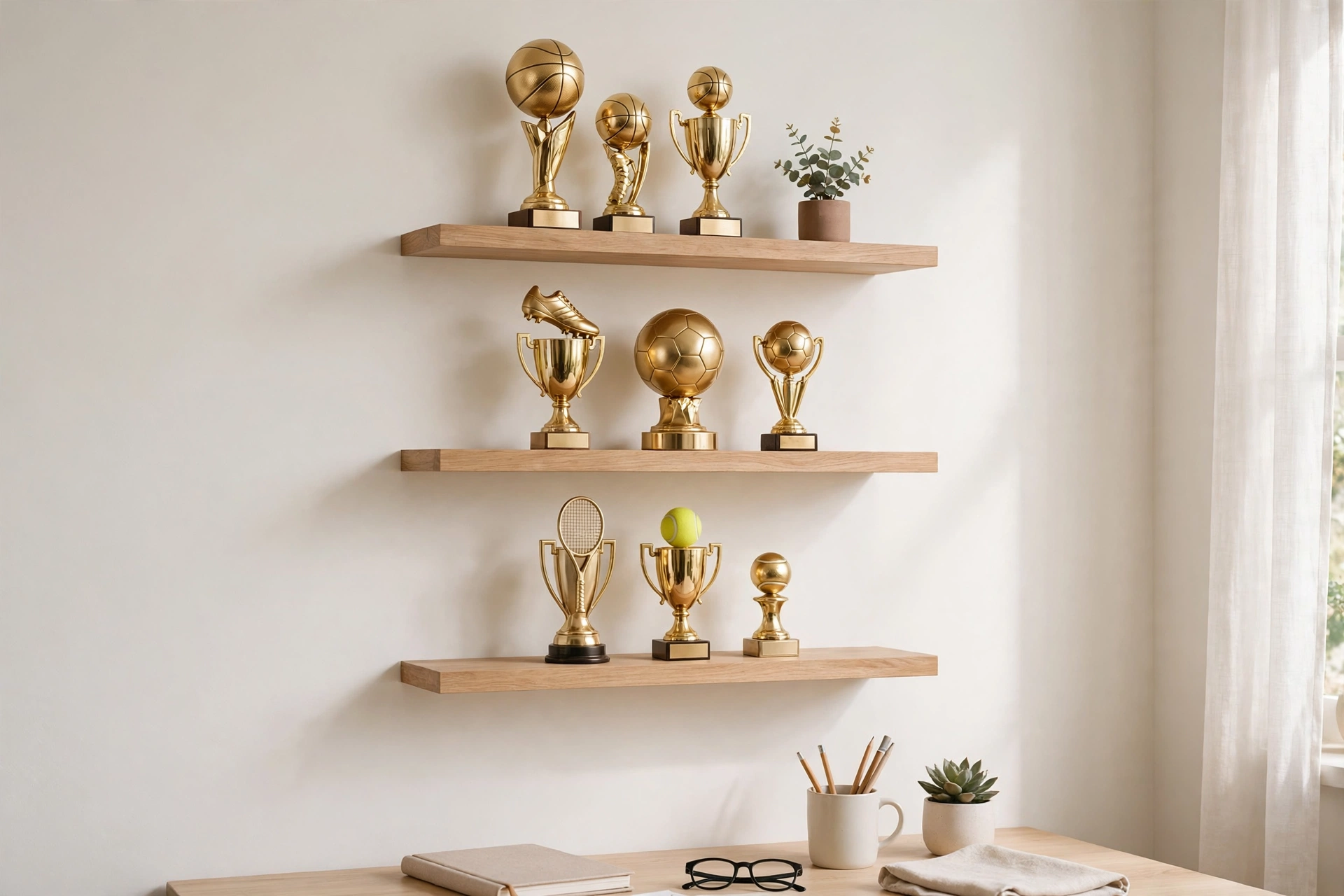
A trophy display shelf works well because it is narrow, cheap, and easy to mount. Two or three floating shelves stacked on one wall hold a surprising number of trophies, and they keep the cups at eye level where people can see them. Leave a little space between each trophy so the cups do not touch. A shelf packed edge to edge looks crowded, and crowded shelves are where trophies get knocked over.
If the collection is bigger, a bookcase does the same job with more room. Give trophies the top two shelves and books the rest, or give one whole bookcase to the collection if it is large enough. The trick is the same either way: one spot, grouped together, with space to breathe. A single trophy spot is the heart of these trophy storage ideas, because one grouped display reads as a collection instead of clutter. These trophy storage ideas work because the display has a clear edge — when the shelf is full, the collection is full, and the next trophy means a choice, not another pile.
For more display options, PW Engraving’s guide to storing trophies walks through floating shelves, display cases, shadow boxes, and a ceiling shelf for trophies that need to stay out of reach.
How to Display Trophies Without Cluttering the Room
Knowing how to display trophies is mostly about grouping. Sort the display pile before it goes up: by sport, by person, or by year. A row of soccer trophies together tells a story. A shelf mixed with a spelling cup, a dance trophy, and a science fair ribbon tells nothing. Pick one grouping and use it across the whole display.
Height order helps too. Put the tallest trophies in the middle or at the back, and the short ones at the front or the ends. That way no trophy hides behind another, and the shelf reads as one neat row instead of a jumble.
If two trophies are the same height, leave a gap between them rather than lining them up like soldiers. A little air makes the shelf look calm. That spacing rule is a small part of good trophy storage ideas, but it is the part people notice first when they walk into the room.
A trophy wall display takes this one step further. Instead of shelves, mount a few small ledges or picture rails on one wall and line the trophies along them. A wall display works well in a hallway or a home office, where floor space is tight but wall space is free.
If the office is small, small home office organization ideas like a single trophy wall keep the desk clear while the wins stay visible. It also keeps trophies out of reach of small hands and wagging tails. Keep the top ledge for the trophies that matter most, since eyes go there first.
Light matters more than most people think. A shelf in a dark corner makes gold look brown. A shelf near a window looks great but fades ribbons and cracks plastic over time. The sweet spot is a wall that gets soft, indirect light, with a small LED strip or a picture light above the shelf if the room is dark. Good trophy shelf ideas always include light, and these trophy storage ideas are no different, because a trophy nobody can see clearly might as well be in a box.
When a Trophy Case Is Worth It
A trophy case for home use is worth the money when the collection includes anything fragile, valuable, or easy to break. Glass doors keep dust off, keep little hands out, and keep a top-heavy cup from tipping onto the floor. A case also makes a small collection look serious: five trophies in a glass cabinet look like a museum piece, while five trophies on a shelf look like a shelf.
Pick a case with adjustable shelves, because trophies are not all the same height. A tall cup needs a tall space, and a short plaque needs a short one. Fixed shelves waste space and force you to lay trophies on their sides, which is how the little figures snap off. Measure your tallest trophy before you buy, and add an inch for the base.
Glass matters too. Plain glass is fine for a living room, but a case near a sunny window should have UV-filtering glass, or the ribbons and engraved plates will fade over a few years. If the case has a lock, use it for the trophies that cannot be replaced. The rest can stay open for the kids to hold and show their friends.
A case is not the answer for every collection. If you have thirty trophies and a small room, a case will hold five and the other twenty-five still need a box. That is fine.
The case holds the best five, and the box holds the rest safely. Smart trophy storage ideas never force the whole collection onto display — they pick the winners for the wall and protect the rest. A case plus a box is the pair most families land on, and these trophy storage ideas stay simple because the case holds the best five and the box holds the rest.

Shadow Boxes for the Special Ones
A shadow box trophy display is the best home for a trophy that is small, light, or fragile. A shadow box is a deep frame with a glass front, and it holds one trophy — or one trophy plus its medal and a photo — behind glass where dust and fingers cannot reach it. It hangs on the wall like a picture, so it takes no shelf space at all.
Shadow boxes work best for the trophies that tell one clear story: the first trophy, the championship cup, the award that took a whole season to win. Put the trophy in the center, add the medal on a small hook beside it, and tuck a photo or the event program behind it if it fits. Keep it simple. A box stuffed with five items looks messy behind glass.
Mount shadow boxes at eye level, in a spot where people stop and look — a hallway, the wall beside the front door, or the home office wall behind the desk. Hang them with real wall anchors, not a single small nail, because a loaded shadow box is heavier than a picture frame. If the trophy inside is tall, pick a box at least two inches deeper than the trophy is wide, so the glass never presses on the cup.
One warning: shadow boxes are addictive. They look so good that it is tempting to buy one for every trophy. Resist that.
One or two shadow boxes make a wall special. Ten shadow boxes make a wall into a shop. Save the boxes for the trophies that earned them. That restraint is what keeps these trophy storage ideas looking like a home instead of a shop.
The Trophy Storage Box for Everything Else
Most trophies will not live on a shelf, and that is fine. A trophy storage box is where the keep pile lives, and a good box keeps trophies safe for years. The wrong box — a big cardboard box with everything tossed in — is where trophies go to break. The right box has three things: dividers, wrapping, and a label.
Start with a sturdy plastic bin with a lid, not a cardboard box. Cardboard sags, gets damp, and invites bugs. Plastic keeps moisture out and stacks neatly.
Pick a bin that is wider than it is deep, so trophies can stand upright instead of lying on their sides. If the bin is too tall, trophies tip over inside it. If it is too short, the cups stick up and the lid crushes them.
Wrap each trophy before it goes in. A sheet of tissue paper or an old soft cloth around each cup stops the gold from scratching and the little figures from snapping off. Stand the wrapped trophies upright, with a piece of cardboard or a small divider between them so they do not lean on each other. Ribbons and medals go in a separate zip bag on top, never tangled around the cups.
Label the outside of the box with what is inside: the sport or activity, the years, and whose trophies they are. “Soccer 2022–2024, Maya” beats “trophies” every time. A label means you can find one trophy in a minute instead of opening four boxes. Trophy keepsake storage only works when the box tells you what is in it without being opened. A box that tells you what is inside is the quiet hero of these trophy storage ideas, because it turns a search into a one-minute job.
Store the box somewhere dry and steady: a closet shelf, the top of a wardrobe, or under a bed. Avoid the attic in summer and the garage in winter, because heat and damp warp plastic and dull gold. A box in a bedroom closet beats a box in a hot attic every single time. A cool, dry closet is the best home for a box, and these trophy storage ideas only work when the box itself stays dry and steady.
Kids Trophy Organization That Grows With Them
Kids trophy organization needs a different rule from adult collections, because kids collect trophies fast. A child who plays two sports and joins a school club can bring home six trophies a year. In five years that is thirty trophies, and no shelf holds thirty.
Give each child one shelf and one box. The shelf holds the current favorites — five trophies at most. The box holds the rest.
When a new trophy comes home and the shelf is full, the child picks one trophy to move into the box. That one choice teaches more about keeping what matters than any lecture about clutter. The shelf stays fresh, the box stays honest, and nothing gets thrown away in secret. That one-shelf rule is the core of kids trophy storage ideas that actually last, because a limit the child can see is a limit the child can keep.
Let kids help with the sorting. Ask them which trophy they would show a friend first, and that one goes on the shelf. Ask which one they would keep if they could only keep three, and those three never go in the let-go pile. Kids who choose their own display take care of it, and they put trophies back on the shelf instead of leaving them on the floor.
A small habit helps a lot: when a trophy comes home, it goes on the shelf the same day, not on the kitchen counter for a week. A trophy that sits on a counter for a week becomes part of the counter. A trophy that goes straight to its spot becomes part of the collection. This is the same kind of small routine that makes fall home office organization ideas work — a fixed spot, used the same day, every time.
Rotate the display twice a year, at the start of a new season. Pull the shelf trophies down, wipe the shelf, and let each child swap in two trophies from the box. The swap takes ten minutes and makes the display feel new without buying anything. To rotate trophy display pieces on a schedule is the cheapest way to keep a kids’ collection feeling alive. A twice-yearly swap is the cheapest part of these trophy storage ideas, and it keeps a kids’ collection feeling new without buying a thing.
Trophy Cleaning and Care in Five Minutes
Trophy cleaning and care is simple, but it has to happen before the dust turns into a film. Dust a display shelf once a month with a dry, soft cloth. Do not use a wet cloth on gold cups, because water spots show on gold and tarnish shows on silver. A feather duster reaches between trophies without knocking them over, and it takes two minutes for a whole shelf. Dusting once a month is the smallest habit in these trophy storage ideas, and it is the one that keeps gold looking gold.
For a trophy that is already dull, a soft cloth with a tiny bit of mild soap and water works on most metal cups. Wipe gently, dry it right away, and never scrub. Engraved plates are the delicate part: the letters fill with dust, and a soft toothbrush lifts it out without scratching. Never use polish on an engraved plate unless you know the metal, because polish can strip the dark filling out of the letters.
Keep trophies out of direct sun. Sunlight fades ribbons, cracks plastic bases, and turns gold a flat yellow over a few years. If the only shelf is near a window, move the shelf or hang a curtain.
Heat is the other enemy: a shelf above a radiator or next to a heater dries out glue and loosens the little figures on top. Cool, dry, and out of the sun is the whole rule. These trophy storage ideas hold up for years when that rule holds.
Stored trophies need a check once a year. Open the box, look for damp, bugs, or a trophy that has tipped over and pressed on another one. Re-wrap anything whose tissue has torn, and replace a cracked bin before it sags. A five-minute check once a year saves a box of broken trophies.

Display or Store? A Quick Comparison
| Option | Best for | Cost | Protection | Space needed |
|---|---|---|---|---|
| Floating shelves | 5–15 trophies, daily viewing | Low | Low — open to dust | One wall |
| Bookcase | 10–30 trophies, mixed rooms | Low–medium | Low — open to dust | One bookcase |
| Glass trophy case | Best 5–10, fragile or valuable | Medium–high | High — dust-free, locked | Floor or wall unit |
| Shadow box | 1 special trophy + medal | Low–medium | High — sealed behind glass | Wall space |
| Labeled storage bin | The rest of the collection | Low | High — wrapped, lidded | Closet shelf |
| Ceiling shelf | Out-of-reach display | Low | Medium — safe from hands | High wall strip |
Use the table like a menu, not a shopping list. Most homes need two rows from it, and these trophy storage ideas work best as a pair: one display row and one storage row. A shelf plus a bin covers almost every family. A case plus a shadow box covers a serious collector. Pick the pair that fits your count from the sorting step, and stop there.
7 Mistakes That Break Trophies
These are the mistakes that break trophies, and avoiding them is the cheapest part of these trophy storage ideas.
- Stacking trophies on top of each other in a box. The weight snaps figures and scratches gold. Stand them upright, wrapped, with dividers.
- Storing trophies in a damp garage or a hot attic. Damp dulls metal and heat warps plastic bases. Keep boxes in a dry closet.
- Laying a trophy on its side on a shelf. A top-heavy cup rolls, falls, and breaks. If it does not stand up, it belongs in a box.
- Packing a shelf edge to edge. Crowded trophies get knocked over when someone reaches for one. Leave a finger-width gap between cups.
- Using a wet cloth on gold cups. Water spots show on gold and tarnish shows on silver. Dust dry, wipe damp only when dull, and dry at once.
- Forgetting to label the storage box. An unlabeled box means opening four bins to find one trophy. Label the sport, the years, and the name.
- Buying storage before sorting. A shelf bought for thirty trophies cannot hold the five you actually want to display. Sort first, count second, buy last.
FAQ
How many trophies should I display at once?
Five to ten is the sweet spot for most homes. One shelf or one case holds that many without looking crowded. The rest go in a labeled box, and you rotate two or three onto the shelf each season. A display that changes feels fresh, while a shelf packed with thirty trophies just looks full. That rotation is what keeps these trophy storage ideas fresh, because the shelf never holds more than it should.
What is the best way to store trophies long term?
Stand them upright in a sturdy plastic bin with a lid, each one wrapped in tissue paper or a soft cloth, with cardboard dividers between them so they do not lean on each other. Label the bin with the sport, the years, and the name. Keep the bin in a dry closet, not a hot attic or a damp garage, and check it once a year. That routine is the whole secret of trophy storage ideas that last: a good bin, a clear label, and a yearly check.
Do trophies fade in sunlight?
Yes. Direct sun fades ribbons, cracks plastic bases, and dulls gold over a few years. Keep display shelves out of direct sun, and pick a case with UV-filtering glass if the only spot is near a window. Soft, indirect light shows trophies off without harming them.
How do I clean a dusty trophy without damaging it?
Dust it dry with a soft cloth or a feather duster once a month. For a dull metal cup, wipe gently with a soft cloth and a little mild soap and water, then dry it right away. Use a soft toothbrush on engraved plates to lift dust from the letters, and never scrub or use polish on a plate unless you know the metal.
A Shelf That Shows the Wins
Trophies are not clutter. They are proof of seasons played, races run, and work finished. They only look like clutter when they have no home.
Give the best ones a shelf or a case where people can see them, give the rest a labeled box where they stay safe, and give the kids one shelf they can manage themselves. That split — display the best, box the rest — is the simplest version of these trophy storage ideas, and it works for any size collection. Then the collection stops growing across the house and starts telling the story it was meant to tell.
Start with the sort. Pull every trophy onto one table, pick the five worth displaying, and put the rest in a box with a label. That one afternoon is the whole job. After that, these trophy storage ideas mostly run themselves: a new trophy goes on the shelf, an old favorite goes in the box, and the wins stay where you can see them.