
Tablecloth storage ideas matter most the night before a dinner party, when you pull out the good linen cloth and find it creased into a grid of sharp fold lines. You wanted a pretty table; instead you get an hour with the iron, a steaming kitchen, and a cloth that still shows every fold the moment it hits the table.
A tablecloth is a big piece of fabric with nowhere good to live. Folded flat, it takes up a whole shelf. Folded small, it comes out looking like a map. And the holiday cloths — the ones you use twice a year — sit at the bottom of a pile, picking up dust and smells while you forget they exist. The fix is not more shelf space. It is one honest sort, one storage method per cloth type, and labels you can actually read. These tablecloth storage ideas work whether you own two everyday cloths or a whole holiday collection, and the seasonal check at the end keeps them ready to use.
Sort Your Tablecloths Before You Store Anything
You cannot organize tablecloths while half of them are still scattered across the linen closet, the dining room sideboard, and the box of holiday decor in the garage. Pull them all out onto the bed and look at what you actually own. Most homes find an everyday cotton tablecloth with a stain that never came out, a linen tablecloth saved for guests, two runners from a set that never matched, and a seasonal tablecloth bought on sale and used exactly once.
Sort what is on the bed into three groups. The first group is everyday: the cloths that go on the table every week, plus their matching runners and napkins. The second group is seasonal: holiday cloths, the fancy linen tablecloth for guests, and anything tied to one time of year. The third group is the let-go pile: stained cloths, torn ones, and cloths for a table size you no longer own. That count is the whole point of tablecloth storage ideas — the system fits the cloths you actually use, not the ones you wish you used.
Be strict with the let-go pile. A stained everyday tablecloth that you keep “just in case” is taking the shelf space of a cloth you would actually reach for. Donate the good spares, cut the worn ones into cleaning rags, and keep only the cloths that earn their spot.
Roll, Don’t Fold — The Wrinkle-Free Method
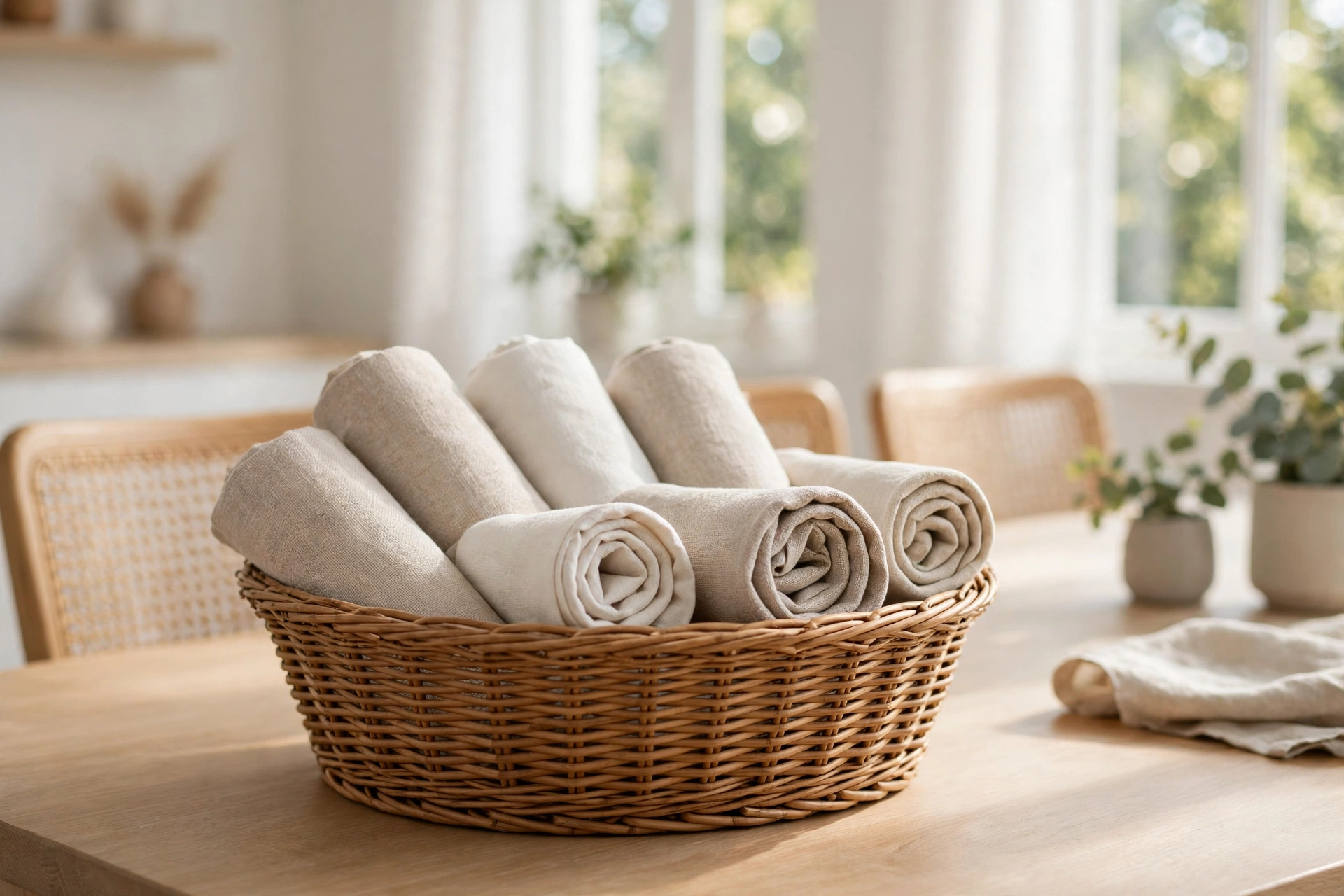
Folding is the habit that ruins tablecloths. Every fold is a sharp crease, and over time those creases set into the fabric so firmly that no amount of ironing fully removes them. Rolling is the single best of all the tablecloth storage ideas for wrinkle control, because a rolled cloth has one gentle curve instead of a dozen sharp angles, and it comes out of storage ready to lay flat with little or no pressing.
Rolling is simple. Lay the cloth flat on a clean surface, face down, and smooth it with your hands from the centre outward. Fold it in half lengthwise once, so it is a long, narrow strip, then start at one short end and roll it firmly toward the other, keeping the roll even as you go. Store the roll flat on a shelf, in a drawer, or standing upright in a tall basket. A cotton tablecloth rolls beautifully and holds its shape; a linen tablecloth benefits most of all, because linen remembers every fold line and forgives almost none of them.
For cloths you use every week, rolling beats folding so clearly that most people never go back. The cloth unrolls, you shake it once, and it lies flat. No iron, no steamer, no last-minute panic before guests arrive.
The Tube Trick for Linen and Holiday Cloths
A rolled cloth is good; a cloth rolled around a tube is better. A cardboard tube — the kind from gift wrap or kitchen foil — keeps the roll wide and gentle, so the fabric never bends tightly enough to crease. Wrap the tube in clean cotton or acid-free tissue first, so no cardboard dye or glue touches the fabric, then roll the cloth around it the same way you would roll it on its own.
The tube method is the gentlest of the tablecloth storage ideas for linen and for cloths that sit unused for months. A seasonal tablecloth rolled on a tube and slipped into a breathable garment bag comes out of storage in spring looking the way it went in at Christmas, and the bag keeps dust off without trapping damp the way a plastic bag does. Store the tubes flat on a high shelf or standing upright in a tall basket, and label the end of each tube so you can find the right cloth without unrolling three wrong ones.
Skip the plastic. Sealed plastic bags trap moisture, and a damp cloth stored in plastic grows smells and mildew fast. Cotton bags, old pillowcases, and breathable fabric bins all let the fabric breathe, which is what a cloth stored for six months actually needs. Public Storage’s guide to storing tablecloths and runners walks through the same clean-and-dry-first rule if you want a second opinion before you pack a cloth away for months.
Hang Tablecloths When You Have Closet Room
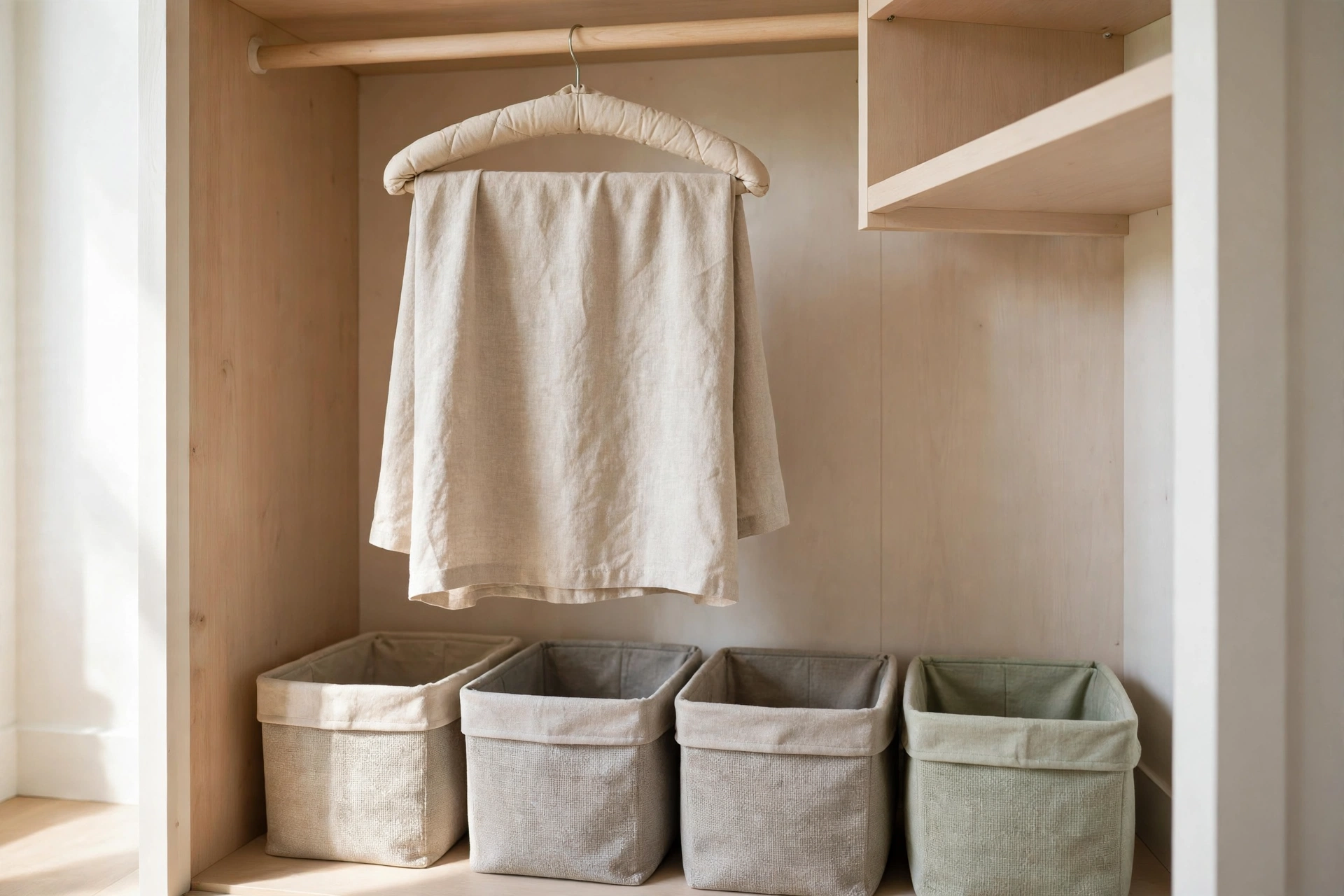
Hanging is the only one of these tablecloth storage ideas that leaves zero creases at all, because the cloth never folds. If you have closet space — even a few inches on a spare rod — it is the best long-term home for a linen tablecloth or a cloth you want to keep perfect. Use a wide padded hanger, never a thin wire one, which leaves a ridge and can rust onto the fabric.
Fold the cloth in half lengthwise once, then in half crosswise once, and drape it over the hanger at the crosswise fold so the two layers hang freely on either side. Cover it with a cotton garment bag to keep dust off while letting air move. One rod can hold four or five cloths this way, and you can see every one of them at a glance, which beats digging through a folded stack every time.
Hanging suits the cloths you use in the next few weeks and the special ones you want to protect. The everyday cloths can live rolled in a bin, where you grab them fast; the hanging rod is for the cloths worth keeping crease-free.
Bins, Baskets, and the Linen Shelf
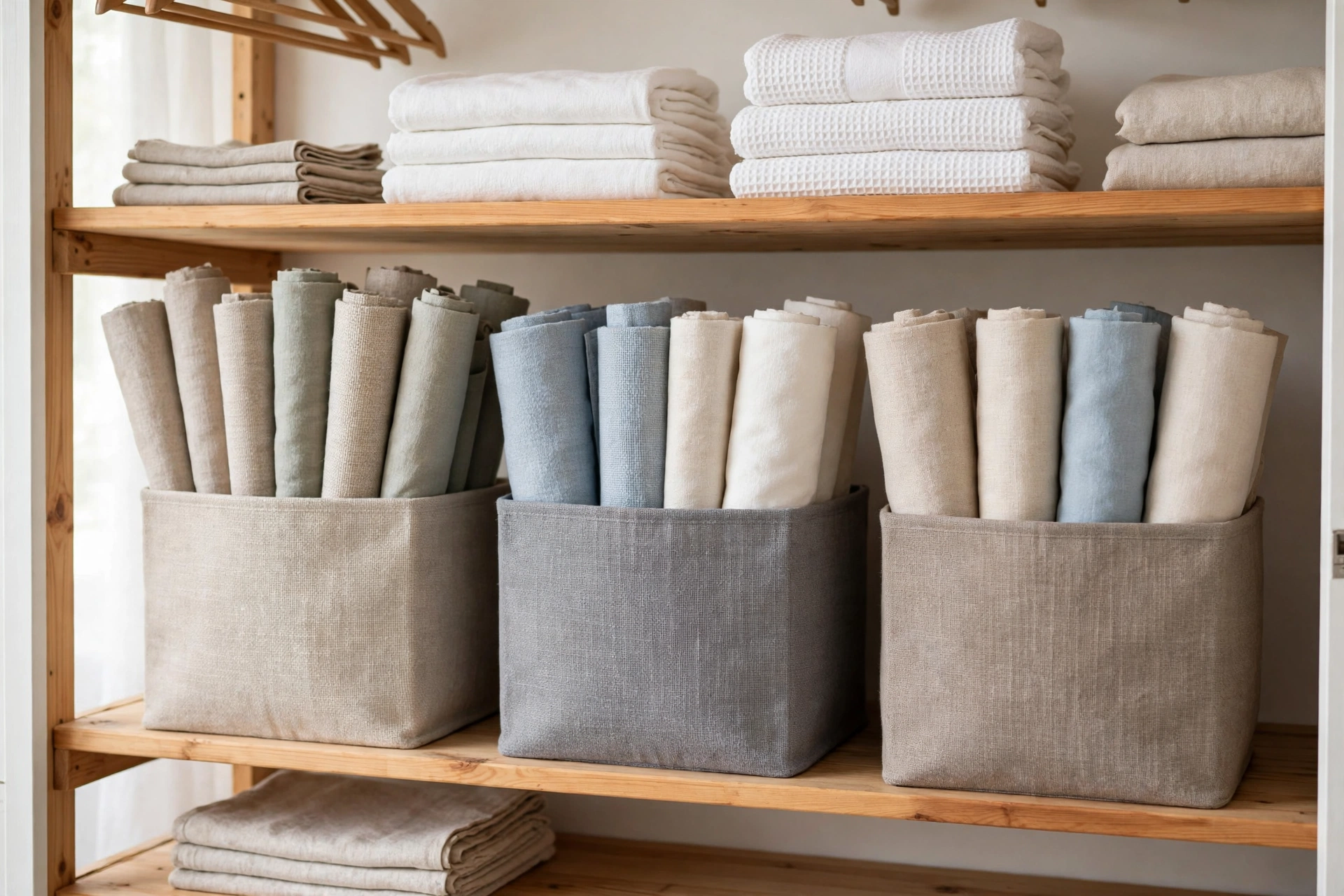
Not every home has spare closet room, and that is where bins earn their keep. A fabric bin on a linen closet shelf holds three or four rolled cloths standing upright, each one visible from the top, and a label on the front tells you which is which without unrolling anything. Labeled bins are the most practical of the tablecloth storage ideas for renters, because nothing is drilled, nailed, or built in — a bin, a shelf, and a label maker are the whole system, and the rental friendly organization ideas guide uses the same bin-and-label rule for everything else in a rental.
Give each bin one job. One bin for everyday cloths, one for seasonal cloths, one for runners and napkins. A table runner rolls up small and fits in the same bin as its matching cloth, and napkins stack flat in a shallow basket on top. If a bin holds more than one cloth, stand the rolls upright like files in a drawer, tallest at the back, and put a small card in front of each roll with the cloth’s size and colour. A bin that holds five mystery rolls is a junk drawer with better branding; a bin with three labeled rolls is a system. That is the difference between storage and a system, and it is why tablecloth storage ideas that include labels outlast the ones that do not.
Keep the heavy cloths low and the light ones up high, and never stack a heavy box on top of a bin of rolled cloths. The rolls will flatten, the fabric will crease under the weight, and you will be back to ironing the night before the party.
Seasonal vs Everyday: Two Zones
Two zones are what make tablecloth storage ideas work in a small home, because everyday cloths and holiday cloths have opposite needs. Everyday cloths need to be fast: rolled, labeled, and within reach of the dining table. Seasonal cloths need to be safe: clean, dry, protected, and out of the way until their season comes around.
Put the everyday zone where you set the table — a linen closet shelf near the dining room, a drawer in the sideboard, or a basket on a pantry shelf. Put the seasonal zone up high or in a guest-room closet, where it is out of the daily path but easy to reach when the holidays come. Label both zones by season, not by colour, so “Christmas” and “Thanksgiving” mean something at a glance and you are not guessing which red cloth is which.
When a season ends, wash the cloths before they go back into storage, even if they look clean. Food smells and tiny stains set over months, and a cloth stored dirty attracts moths and comes back worse than it went in. The budget organization ideas guide uses the same wash-first rule for anything stored long term, and it holds for tablecloths too — a clean cloth stored well costs nothing, and a dirty one stored badly costs you the cloth.
Runners, Placemats, and Napkins Belong With Their Cloth
A tablecloth system that forgets the small pieces is only half a system. A table runner is a long, narrow cloth, and it stores best rolled around a tube just like a full cloth — roll it loosely, wrap it in acid-free tissue, and keep it with the cloth it matches. Placemats stack flat in a shallow basket or stand upright in a vertical file bin, one set per slot, and cloth napkins fold into a small stack in the same bin as their cloth.
The same rules that make tablecloth storage ideas work also cover runners: clean, dry, rolled or hung, never sealed in plastic, and labeled so you can find the set without opening every bin. Keep each table setting together — cloth, runner, napkins, and placemats in one bin — and setting the table for a holiday dinner becomes a five-minute job instead of a hunt through three closets.
Pick the Right Storage for Your Cloths
Not every method fits every cloth, so match the storage to the fabric and how often you use it — these tablecloth storage ideas are a menu, not a shopping list.
| Storage method | Best for | Watch out for |
|---|---|---|
| Rolled flat on a shelf | Everyday cotton tablecloths, fast access | Rolls can flatten if stacked under weight |
| Rolled on a tube | Linen tablecloths, seasonal tablecloths | Wrap the tube in tissue first |
| Hung on a padded hanger | Special cloths, crease-free storage | Needs closet rod space |
| Fabric bin with labels | Renters, small linen closets | Keep bins to one cloth type each |
| Garment bag on a tube | Holiday cloths stored for months | Skip plastic bags, use breathable cotton |
Rolling wins for most homes because it is fast, cheap, and kind to the fabric. The tube is the best upgrade for linen and holiday cloths, and hanging is the best choice when you have the rod space and want zero creases. Pick one method for the everyday cloths and one for the seasonal ones, and stop buying storage until the first one is full.
Keep It Working With a Seasonal Check
Tablecloths stay organized only if someone checks them when the seasons turn. Build a short check into the same day you do your weekly cleaning schedule, twice a year, and the linen closet never gets bad enough to need another big sort:
- Pull out every cloth, shake it out, and check for stains, smells, or moth damage before it goes back.
- Re-roll any cloth that has been sitting folded, and change the fold lines on the ones you still fold.
- Wash the seasonal cloths before they go back into storage, and let them dry fully first.
- Check the labels — one cloth per bin slot, and the label still matches what is inside.
- Move any cloth nobody used this season to the let-go pile, and note which sizes you actually need.
Five minutes a season is all it takes, and it is the habit that turns a one-time tidy-up into tablecloth storage ideas that still work a year from now.
Frequently Asked Questions
What is the best way to store tablecloths without wrinkles?
Roll them. A rolled cloth has one gentle curve instead of a dozen sharp fold lines, so it comes out of storage ready to lay flat. For linen, roll the cloth around a tube wrapped in acid-free tissue. That is the simplest of all the tablecloth storage ideas, because it needs no special equipment and no ironing the night before a party.
Should I fold or roll a linen tablecloth?
Roll it, every time. Linen remembers fold lines more than any other fabric, and a crease pressed into linen over months is hard to remove even with steam. Roll the linen tablecloth around a cardboard tube covered in clean cotton or acid-free tissue, slip it into a breathable garment bag, and store it flat on a shelf or standing in a tall basket.
How do I store tablecloths in a small apartment?
Use one fabric bin per cloth type on a linen closet shelf, with the cloths rolled and standing upright like files. Everyday cloths go in the bin nearest the dining table; seasonal cloths go up high in a garment bag. A tall basket in the corner of a closet holds rolled tubes upright and takes up less than a square foot of floor. The best tablecloth storage ideas for small spaces all use height and labels, not more shelves.
How should I store a tablecloth for a long time?
Wash it, dry it fully, roll it on a tube wrapped in acid-free tissue, and slip it into a breathable cotton garment bag. Store it flat on a shelf in a cool, dry place, and never seal it in a plastic bag — trapped moisture grows mildew and smells. Check it once a season, re-roll it, and it will come out looking the way it went in.
A Table That Is Ready When Guests Are
A good tablecloth setup does not make you think. You reach for the cloth, it unrolls smooth, and the table looks dressed without an hour of ironing. That is what good tablecloth storage ideas buy you — a home that is ready for guests on a busy evening instead of fighting you. Start tonight: pull the cloths out, keep the ones you actually use, roll the everyday ones, tube the holiday ones, and label every bin. One small sort turns a creased pile into a system that works — and it stays that way with five minutes a season.