

School Supplies Organization Ideas That Make School Mornings Calm
School supplies organization ideas matter most at 7:30 in the morning, when the bus leaves in ten minutes and nobody can find a pencil. Pencils, crayons, glue sticks, and notebooks show up one at a time — a free pencil from a birthday party, a half-used notebook from last year, a glue stick with no cap — and they spread across the kitchen table, the couch, and the bottom of a backpack. By October the house holds twice as many supplies as any kid needs, and none of them are where they should be.
The fix is a simple system, not more shopping. Every school supply gets one home, the things kids grab daily stay within reach, and the extras move out of the way. These school supplies organization ideas work in a small bedroom, a shared homework corner, or a rented apartment where you cannot drill a single hole, and most of them cost less than a family pizza night.
Below you will declutter the whole pile, set up a homework station that kids actually use, sort pencils and small stuff so nothing gets lost, build a backpack system that survives the week, and add a five-minute reset that keeps it all working. Follow the steps in order, and these school supplies organization ideas will make school mornings feel calmer by next week.
Start With a School Supplies Declutter
The first of these school supplies organization ideas is the least fun and the most useful: gather every pencil, crayon, marker, notebook, and glue stick in the house into one pile. Check every backpack pocket, every junk drawer, the car, and the bottom of the closet. Most families find twice as many pencils as they thought they owned — and at least three dried-out markers nobody will miss.
Sort the pile into three groups: keep, donate, and toss. Keep the supplies your kids actually use. Donate the good extras — the unopened notebooks, the new crayon packs — to a classroom or a neighbor. Toss the broken crayons, the dried markers, and the pencils chewed down to stubs. A school supply declutter works best when you are strict: if nobody used it last school year, it does not earn a spot in the caddy this year.
While the pile is sorted, count what each kid owns. A pencil case holds about ten pencils, five pens, and a few highlighters — that is plenty for a school week. Extra supplies sound helpful, but they are what fills the drawers and hides the pencil your kid actually wants. Fewer supplies, each with a home, beats a drawer full of spares nobody can find — and that is the whole point of school supplies organization ideas.
Give Every Supply a Home
Zoning is the heart of school supplies organization ideas that last, because supplies live or die by where kids sit down to work. Put the school gear where homework happens: a caddy on the desk, a small shelf above it, and a bin below for notebooks and workbooks. When the pencils live ten steps from the desk, homework starts with a hunt instead of a pencil.
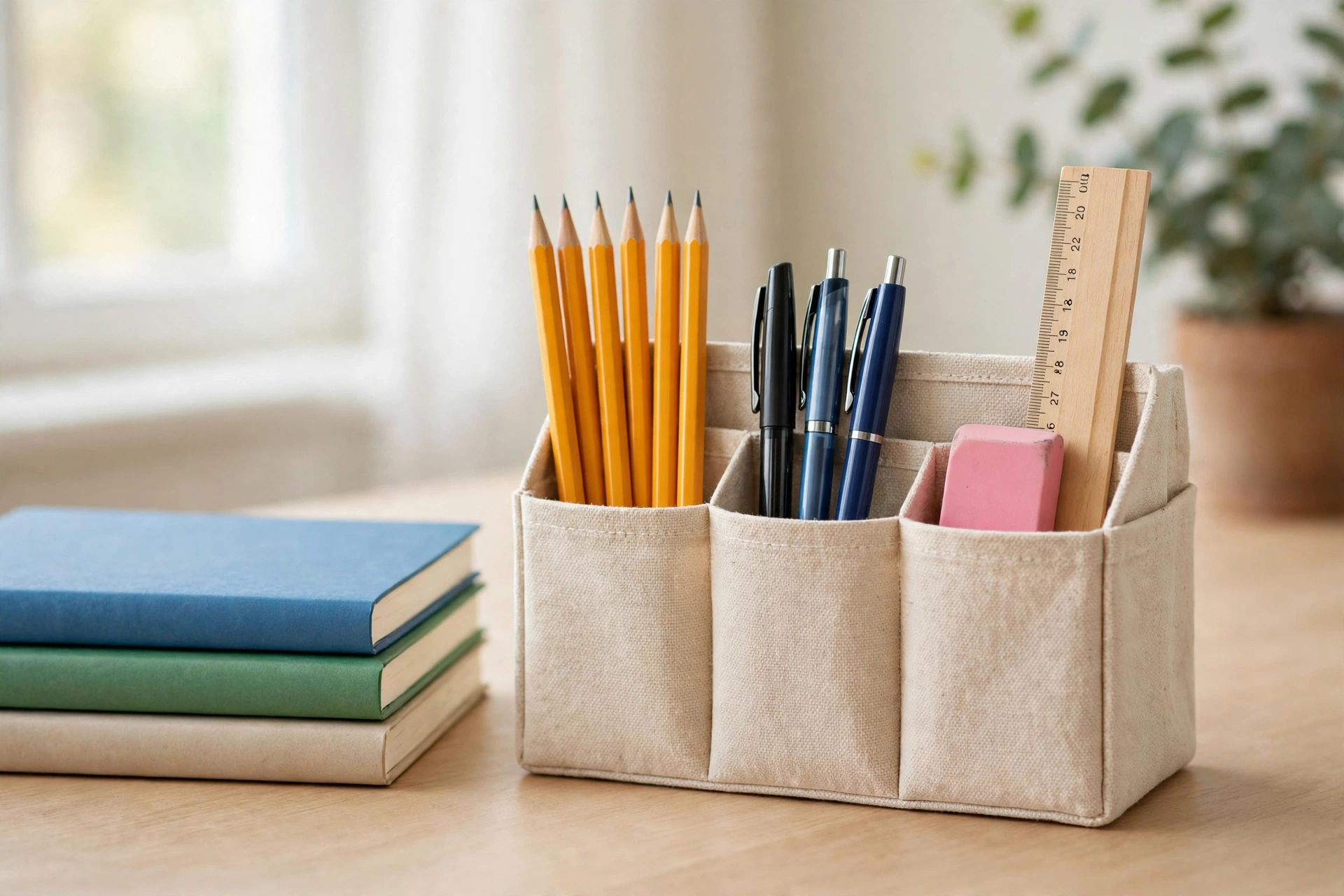
Give each kid one caddy and one small bin. The caddy holds the daily tools — pencils, pens, an eraser, a ruler — and the bin holds notebooks and folders. Label bins with names or colors so kids can find their own gear without asking, and so a sibling’s math workbook never ends up in the wrong bag. Labeled bins also make the morning run smoother, because each kid grabs their own bin and goes.
A small bedroom works fine with this setup — one caddy on the desk and one basket on the floor is enough for a whole school year. That is kids desk organization at its simplest: a caddy, bins, and one rule about where things live. Most of this setup costs under $25 — our budget organization ideas guide lists the cheapest bins and caddies that actually last.
If the desk is shared, give each kid a labeled drawer or a colored caddy so nothing gets mixed up. A rolling cart works well when homework moves around the house: park it by the table at homework time, roll it back to the corner when dinner starts. If your kids do homework at the kitchen table, a portable caddy with a handle carries everything in one trip.
Our small kids room organization ideas guide shows how to carve a homework corner out of a small bedroom, and the same thinking applies here: use the space you already have instead of buying a bigger desk. A bedroom with no desk still has a shelf, and a shelf with a caddy is a homework station.
Set Up a Homework Station Kids Actually Use
A homework station is just a spot where everything a kid needs sits within arm’s reach. The layout is simple: a flat surface to write on, a caddy with pencils and pens, a shelf or bin for notebooks, and a hook for the backpack. Everything in it gets used daily, so nothing in it is decoration.
Keep the station boring on purpose. A station with too many cute containers becomes a toy, and a station with one caddy and one bin becomes a habit. Put the pencil sharpener, the ruler, and the eraser in the caddy, and keep the craft supplies somewhere else — glitter glue does not belong next to a math worksheet.
Set the station up together, and let each kid pick their caddy color and label their bin. Kids who helped build the system are far more likely to use it, and a labeled bin feels like theirs in a way a shared pile never does. Put a small clock nearby so kids can see their homework time, and keep a water bottle on the desk so nobody has an excuse to wander off.
The station also needs a rule everyone agrees on: supplies come out at the station and go back to the station. No pencils on the couch, no notebooks on the kitchen counter. When the rule slips, the five-minute reset below puts it right again. Our small home office organization ideas guide uses the same one-home rule for desk gear, and it works just as well for a kid’s homework corner.
Pencil Cases, Pouches, and Small Stuff
Small supplies cause the most school mornings to go wrong, so school supplies organization ideas for pencils and pens focus on one thing: keep the daily set small and together. A pencil case that holds ten pencils, three pens, an eraser, and a sharpener is a case a kid can actually carry. A case stuffed with forty pencils is a junk drawer with a zipper.
Give each small thing its own spot inside the case. Pencils in the main pocket, pens in the side pocket, eraser and sharpener in the little mesh pocket. A drawer organizer tray on the desk catches the spares — extra erasers, extra glue sticks — so the case never has to hold them. A desk drawer organizer with small compartments works for paper clips, binder clips, and sticky notes too, and drawer dividers keep them from sliding into one pile.
Check the case every Sunday night. Toss the broken pencils, sharpen the dull ones, and top it back up to ten from the spare stash. A pencil case that holds only working tools is a case a kid can trust at 7 a.m. in the dark, and that trust is the whole point of a system.
Spare supplies live in one labeled bin on the shelf, not scattered through five drawers, so there is only one place to look.
Backpack Organization That Sticks
The backpack is where school supplies organization ideas either work or fall apart, because a backpack with no system becomes a black hole by Wednesday. The layout is simple: big pocket for notebooks and folders, front pocket for the pencil case, side pocket for the water bottle, and the small pocket for the things that get lost — the lunch money, the library card, the permission slip.
Pack the bag the night before, not in the morning. Packing the night before is the simplest of all school supplies organization ideas, and it saves the most morning stress. Books and folders go in first, then the pencil case, then the lunchbox.
A backpack hook by the door holds the packed bag so the morning starts with grabbing, not packing. A cubby storage bin by the door works just as well when there is no wall for hooks. A backpack organization system works best when the bag has the same home every night — the hook, the cubby, or the bin by the door. A small supply checklist taped inside the front pocket reminds kids what goes back in each morning.
Teach kids to empty the bag every Friday. Old papers come out, crumbs get shaken out, and the pencil case gets checked. A Friday clean-out takes three minutes and keeps the bag from turning into a paper landfill. Our small closet organization ideas guide shows how a hook and a bin by the door can hold a whole family’s bags, and the same two hooks that hold winter coats can hold backpacks in September.
Art Supplies Without the Mess
Crayons, markers, and colored pencils are school supplies too, and they need their own rules or they end up everywhere. This is where school supplies organization ideas get tested, because crayons and markers multiply faster than pencils. Keep art supplies in one caddy, separate from the homework pencils — the homework caddy stays on the desk, and the art caddy lives on a shelf until art time. A school supply caddy with a handle carries the art gear to the table and back in one trip.
Sort art supplies by type, not by color: all the markers together, all the crayons together, all the colored pencils together. A cup or a small jar per type keeps things visible, and kids can see at a glance what is running low. Washable markers only for younger kids — the washable kind saves the table, the shirt, and the couch.
When the art caddy fills up, that is your signal to declutter again — a full caddy means too many supplies, not too little space. Broken crayons go in the trash, dried markers go in the recycling, and the good extras go to the classroom donation box. Our fall closet organization ideas guide covers the seasonal swap, and the same ten minutes that swaps summer clothes can sort the art supplies for the new school term.
The Lunchbox and Morning Station
A lunchbox station is the school supplies organization ideas habit that saves the most morning time, because lunch packing and supply packing happen at the same moment. The layout is simple: lunchboxes on one shelf, water bottles in a bin, snack containers in another bin, and the backpack hook right beside them. Everything a kid needs to leave the house sits in one square meter.
Pack lunches the night before and set them in the fridge, so the morning is only grab-and-go. Keep a school morning routine checklist on the wall by the station: backpack packed, lunch in the bag, water bottle filled, shoes on. Kids who can read the list can run their own morning, and a checked list beats a shouted reminder every time.
A small tray on the shelf catches the things that fall out of pockets — the library card, the lunch money, a hair tie. When the tray fills up, empty it on Sunday night. A morning station that holds the whole family’s school gear in one spot is just entryway organization with a lunchbox, and it makes the school run feel shorter.

A 5-Minute Nightly Reset
The nightly reset is the school supplies organization ideas habit that keeps the rest working, because a tidy homework station is a daily habit, not a weekend project. Set a timer for five minutes after dinner and run the same five moves every night:
- Put every pencil back in the caddy.
- Stack notebooks and folders in the bin.
- Check the pencil case and sharpen one pencil.
- Hang the backpack on its hook.
- Clear the desk of everything that is not homework.
Do it in the same order every night, so it becomes automatic. A weekly reset takes a little longer: wipe the desk, shake out the backpack, and check the spare-supplies bin. Pair it with your weekly cleaning schedule, and the homework corner never needs a big rescue clean again.
Small wins keep the system alive. If five minutes feels like too much, start with two: pencils in the caddy, backpack on the hook. A station that gets a little care every night stays calm, and a calm station makes school mornings feel shorter — which is the whole point of school supplies organization ideas that actually work.
What Goes Where
Use this quick table to decide where things live. The core of school supplies organization ideas is giving everything one home, and this table is the map.
| Supply | Home | Why it works |
|---|---|---|
| Daily pencils and pens | Pencil case in the caddy | Grab and go in five seconds |
| Extra pencils and pens | Labeled bin on the shelf | One place to restock from |
| Notebooks and folders | Bin or shelf by the desk | Easy to see, easy to grab |
| Crayons and markers | Art caddy on a shelf | No mess on the homework desk |
| Backpack | Hook by the door | Packed the night before |
| Lunchbox and bottle | Morning station shelf | Grab-and-go in the morning |
Frequently Asked Questions
What are the best school supplies organization ideas to start with?
Start with the desk: one caddy and one labeled bin per kid. Clear the pile, keep only the supplies your kids actually use, and put the daily tools in the caddy. These school supplies organization ideas work best when you start small — one kid tonight, the rest tomorrow — instead of trying to fix the whole room in one afternoon.
How do I keep my kid’s backpack organized?
Give every pocket a job: big pocket for notebooks, front pocket for the pencil case, side pocket for the water bottle. Pack the bag the night before and hang it on a hook by the door, and empty it every Friday. A backpack with assigned pockets stays tidy because there is only one place for each thing.
How many pencils should a kid keep in a pencil case?
About ten pencils, three pens, an eraser, and a sharpener is plenty for a school week. Keep the spares in a labeled bin on the shelf and top the case up on Sunday night. A case that holds only working tools is a case a kid can trust, and a stuffed case is just a junk drawer with a zipper.
How can I organize school supplies in a small bedroom?
Use the wall and the desk you already have: a caddy on the desk, a small shelf above it, and one bin below for notebooks. A rolling cart works when homework moves around the house, and a portable caddy carries everything to the kitchen table in one trip. Give each kid one caddy and one bin, and move the extras to a labeled box on a high shelf.
Start With One Caddy Tonight
Start with one caddy tonight — put ten pencils, three pens, and an eraser in it, label one bin for notebooks, and hang the backpack by the door — and these school supplies organization ideas will make your school mornings feel calmer by next week. A small bedroom does not need more space. It needs a home for everything, a five-minute reset, and a rule that every item goes back where it lives. Pick the drawer that bothers you most, set a five-minute timer, and begin there. Your school mornings will thank you every day.