

Flashlight storage ideas matter the night the power goes out and you are feeling around in a dark drawer for a torch that may or may not have batteries in it. Most homes own three or four flashlights, and most of them are in the wrong place when they are needed — one in a junk drawer with dead batteries, one in the garage under a pile of boxes, and one in the car that nobody has tested since last winter. A torch you cannot find in the dark is not a torch at all.
The fix is simple: give every flashlight one home, keep the batteries out of the ones you store for months, and test them all on a date you will actually remember. Do that, and these flashlight storage ideas will keep every light ready to grab, stop the dead-battery surprise, and end the habit of buying a new torch every time the lights flicker.
Why Flashlights Go Dead in the Drawer
A flashlight fails for two dull reasons, and neither one is about buying a bad torch. The first is dead batteries, because a torch left in a drawer for a year slowly drains, and the second is worse: a leaking battery. Alkaline batteries left inside a torch for months can leak, and the crusty white stuff that comes out eats the metal contacts until the light will not turn on at all. That is how a perfectly good flashlight becomes junk, and it happens quietly, in a drawer, while nobody is looking.
The Batteries Plus battery-storage guide gives the same warning in plain words: remove batteries from devices you will not use for a while to prevent leakage, because flashlights sitting idle are prime candidates for battery leakage, which can corrode and damage the device. The guide also says to store batteries in a cool, dry place at room temperature, ideally 60 to 77 degrees, keep them in their original packaging until you need them, and use the oldest batteries first. That is why flashlight storage ideas start with the batteries, not the torch itself: a torch with fresh batteries in a cool, dry spot works the night you need it, and a torch with old batteries in a hot drawer does not.
The other thing to know is that heat is the enemy. A flashlight left in a hot car in summer or on a garage shelf above a heater ages far faster than one kept inside the house, because heat speeds up the chemical reactions inside batteries and drains them sooner. Cold is kinder than heat, but a freezing garage still weakens a battery, so the inside of the house wins for the torches you count on. That is the first lesson of good flashlight storage ideas: cool, dry, and inside beats hot, damp, or forgotten.
7 Flashlight Storage Ideas That Actually Work
These seven flashlight storage ideas cover the whole routine, from the hook by the door to the spare batteries in the box. You do not need all seven on day one. Start with one torch per zone, the batteries out of the stored ones, and a test date on the calendar, then add the labels and the charging spot, and the rest falls into place.
1. Give Every Zone Its Own Flashlight
One of the simplest flashlight storage ideas is to stop sharing one torch between four rooms. A home needs a flashlight in the entryway, one in the bedroom, one in the car, and one in the emergency flashlight kit, and each one should stay where it lives. When the power goes out, nobody has time to walk through a dark house looking for the one torch, and the person who finds it first is usually the one who needs it least.
The emergency kit organization ideas guide uses the same one-spot rule for a kit that works: the kit flashlight lives in the kit bin, not in a drawer, and the bin lives in the same place every time. A torch that has one home is a torch you can find with your eyes closed, and that is the whole point of how to store flashlights well. Count the torches you own, pick a home for each one, and write the homes on a scrap of paper stuck inside a cupboard door until the habit sticks. That count is the starting point for flashlight storage ideas in any home: you cannot give a torch a home until you know how many torches you have.
2. Hang One by the Door on a Hook
A flashlight hook by the door is the single most useful spot in the whole house, because the door is where you are when the lights go out, when the dog needs to go out at night, and when you hear a noise outside. Hang a small torch on a hook or a clip right beside the door, at hand height, where anyone in the house can reach it without thinking. A hook costs almost nothing, and a torch on a hook is a torch that never gets buried under other things.
Renters can use this trick too, because a stick-on hook or a clip on a command strip holds a small torch without a single hole in the wall. The rental friendly organization ideas guide uses the same no-drill rule for a home that works: a hook you can peel off at the end of the lease beats a nail you have to fill and paint. Pick a hook that holds the torch by its clip or its loop, test it once by tugging the torch off in the dark, and the door torch becomes the one everyone reaches for first. It is one of the cheapest flashlight storage ideas in this guide, and one of the most useful.
3. Take the Batteries Out for Long Storage
Flashlight battery storage starts with one rule: if a torch will sit unused for months, take the batteries out. Batteries left inside a torch for a long stretch can leak, and the leak corrodes the contacts and kills the light. This is the rule that saves the most torches, and it costs nothing to follow. Pull the batteries out of the camping torch, the spare torch, and any torch you keep for emergencies, and store the batteries beside the torch in a small bag or a battery box.
Keep the batteries in their original packaging or in a battery organizer, with the ends kept apart so they cannot touch each other or a piece of metal. A flashlight organizer that holds the torch and its batteries in one spot works well here, because the batteries and the torch stay together without touching. When you need the torch, the batteries go back in, the light works, and nothing has leaked. This one habit is the heart of flashlight storage ideas for torches you store for months. Flashlight batteries leak most often in the torches nobody checks, so the ones you store longest are the ones that need the batteries out first.
4. Keep Rechargeables on One Charging Spot
Rechargeable flashlight storage is a different job from battery flashlights, because a rechargeable torch is only useful if it is charged. Give all your rechargeable torches one charging spot — a shelf, a small tray, or a corner of the kitchen counter — and put the charger there too, so the torch and its charger never get separated. A rechargeable torch left in a drawer for six months is a dead torch, and a charger in another room is a charger nobody uses.
Pick a spot you pass every day, and make it a habit to set the torch back on its charger after you use it, the same way you plug in a phone at night. If the torch has a low-battery light, check it once a month, and if the torch takes a USB cable, keep a spare cable in the same tray so a lost cable never leaves the torch dead. One charging spot, one cable, one habit — that is how flashlight storage ideas handle rechargeables: the charger is part of the storage, not an afterthought.
5. Label the Battery Size on the Torch
When you label a flashlight with its battery size, you answer the one question every household asks in the dark: which batteries does this one take? Write “AA” or “AAA” or “18650” on a strip of tape around the torch, or on the lid of its storage box, and the next person to grab it knows what to feed it. A torch with no label is a torch that gets opened three times just to check, and a torch with a label is one that gets fixed in a minute.
Labels also stop the mixing. When every torch has its size on it, the AA batteries stay with the AA torches, the rechargeables stay with their own charger, and the oldest batteries get used first instead of sitting at the back of the box. A strip of masking tape and a marker costs nothing, and a printed label on a battery box works even better because you can see the sizes at a glance. One label per torch, written the day it gets its home, is one of the quietest flashlight storage ideas there is, and it is the one that keeps a drawer from turning into a row of mystery torches.
6. Keep a Small One in the Bedroom
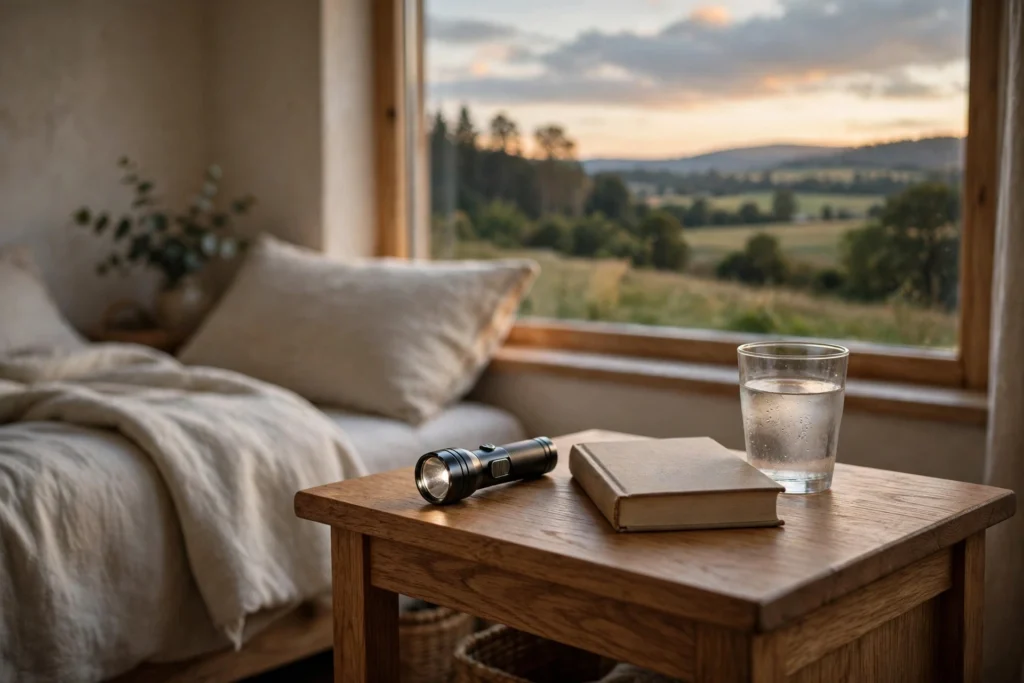
A small flashlight for the bedroom belongs on the nightstand, in the top drawer, or clipped to the bed frame, because the bedroom is where you are when the power goes out at 2 a.m. A big torch is too much for a nightstand, so pick a small one — a pocket torch, a pen light, or a headlamp — and keep it where your hand lands without thinking. A headlamp is a smart pick here, because it leaves both hands free to find the fuse box, check on a child, or walk down dark stairs.
Keep the bedroom torch separate from the rest, and do not borrow it for the garage or the garden, because the one you borrow is the one that is missing when the lights go out. Test it when you change the sheets, and keep a spare set of batteries in the same drawer, so a dead torch at night is a one-minute fix instead of a trip down a dark hall. A bedroom torch is one of the flashlight storage ideas that pays off the first night the power goes out. One small torch, one drawer, one habit — that is all a bedroom needs, and it is the spot that matters most after the door.
7. Give the Car Its Own Flashlight
A flashlight in the car lives in the glove box or in the trunk kit, and it stays there all year, because a car torch that comes inside for a job at home is a car torch that is missing on a dark road. Pick a small torch that fits the glove box, or a bigger one for the trunk kit, and check it when you check the spare tire. The car organization ideas guide runs the same check for the whole car: a quick look on a regular day catches the small problems before they grow, and the car torch deserves the same five minutes.
Heat is the one thing to watch, because a car parked in summer sun gets far hotter than a house, and heat drains batteries fast. A lithium battery handles heat and cold better than a regular alkaline one, so a car torch is the one place where lithium batteries are worth the extra money. Keep the torch in the glove box out of direct sun, or in a small bag in the trunk, and test it at the start of winter and the start of summer. One torch, one glove box, two tests a year — that is the car version of flashlight storage ideas, and it is the one that saves a night on the side of the road.

Where to Store Flashlights
Figuring out where to keep a flashlight starts with how fast you need it, because the best spot is the one your hand finds in the dark. The door wins for speed, the bedroom wins for the middle of the night, and the car wins for the road — and every one of these flashlight storage ideas fits a different home, so here is how the usual spots compare:
| Spot | Best for | Watch out for |
|---|---|---|
| Hook by the entryway door | First grab in a blackout | Keep at hand height, not up high |
| Bedroom nightstand drawer | Night-time outages | Small torch only; test monthly |
| Kitchen junk drawer | Daily grab, quick jobs | Do not let it get buried; one torch max |
| Car glove box | Roadside stops, flat tires | Heat drains batteries; use lithium |
| Trunk emergency kit | Storms, winter driving | Check when you check the spare tire |
| Garage shelf, cool and dry | Spare and camping torches | Batteries out for long storage |
For a small home, the door hook and the bedroom drawer cover almost everything, because one torch at the door and one by the bed means a light is always within a few steps, and the car torch covers the road. A hook by the door, a small torch in the bedroom, and a car torch in the glove box is the simplest version of flashlight storage ideas, and it is the one that works in a flat, a rented house, or a family home alike.
5 Mistakes That Ruin Stored Flashlights
Even a good storage setup fails when one of these habits slips in. Every one of these mistakes is easy to avoid once you know it, and this system of flashlight storage ideas is built around avoiding them. The weekly cleaning schedule guide runs the same kind of check for the whole house: a quick look on a regular day catches the small problems before they grow, and the flashlight shelf deserves the same five minutes.
- Leaving batteries in a torch you never use. A battery left inside for months can leak and corrode the contacts, and the leak kills the light. Batteries out for long storage, every time.
- Tossing loose batteries in a drawer. Loose batteries can touch each other or a piece of metal, and that can short them out or drain them. Keep them in their packaging or a battery box, ends apart.
- Storing a torch in a hot car or a freezing garage. Heat drains batteries fast, and a freezing garage weakens them too. The inside of the house, cool and dry, is the better home.
- Owning one torch for the whole house. One torch gets borrowed, lost, or left in the wrong room, and the house has no light when it matters. One per zone is the rule that fixes this.
- Never testing the torches. A torch you have not tested in a year is a torch you cannot trust. Test them all on the same day, twice a year, and the habit takes five minutes.
Frequently Asked Questions
How should I store flashlights at home?
How to store flashlights at home comes down to three rules: give each torch one home, take the batteries out of the ones you store for months, and test them all twice a year. Hang one by the door on a hook, keep a small one in the bedroom drawer, and keep the spare and camping torches on a cool, dry shelf with their batteries in a box beside them. That is the short version of these flashlight storage ideas: one home per torch, batteries out for long storage, and a test date you will actually keep.
Should I leave batteries in a flashlight?
It depends on how often you use it. For a torch you use every week, leaving the batteries in is fine, because you will notice a weak battery before it leaks. For a torch that sits for months — the camping torch, the spare, the emergency-kit torch — take the batteries out, because flashlight batteries leak most often in the torches nobody checks, and the leak can corrode the contacts until the light will not turn on. Store the batteries beside the torch in a small bag or a battery box, and put them back in when you need the light.
Where is the best place to keep a flashlight?
Where to keep a flashlight depends on when you need it most, but the door wins for most homes: a torch on a hook by the entryway door is the first thing your hand finds when the lights go out. The bedroom comes next, because the middle of the night is the second most likely time, and the car comes third, because a dark road is the worst place to be without one. One torch per zone beats one torch in a drawer every time, and a torch with a home you can find in the dark is a torch that works when it matters.
How often should I test my flashlights?
Test flashlight batteries twice a year, and the easiest dates to remember are the clock changes — when the clocks go forward in spring and back in fall. Turn every torch on, check that the beam is bright, and swap any battery that looks weak or has a crusty white mark on it. That five-minute check is also the moment to put fresh batteries in the door torch, check the car torch, and make sure the rechargeables are on their charging spot. A torch you test twice a year is a torch you can trust, and a torch you never test is a guess.
A Light in Every Room, Ready When You Need It
One hook by the door, a small torch in the bedroom, and a car torch in the glove box is a setup with one less worry, and it is the hook, the label, and the test date that keep flashlights working, not the size of the house. These flashlight storage ideas work because they are simple enough to repeat without thinking about it. Batteries out of the stored torches, the door torch back on its hook, and a test twice a year when the clocks change.
Give every torch one home, label the battery size on it, keep the rechargeables on one charging spot, and check them all on the same day so the oldest batteries get used first. That is what good flashlight storage ideas do: they turn a five-minute habit into a light you can trust, bright and ready and right where your hand lands, and a home where nobody ever has to search in the dark.