

Balcony Organization Ideas That Make a Small Balcony Feel Bigger
Balcony organization ideas start with a simple fact: most balconies are small, and a small space fills up fast. One chair, a plant pot, a bag of soil, and a drying rack — and suddenly there is nowhere to stand, let alone sit with a coffee. The fix is not a bigger balcony. It is a system that gives every item a spot, keeps the floor clear, and treats the walls and railing as storage, not decoration. That is the whole point of these balcony organization ideas: a balcony you can actually use, every day, without tripping over it first.
This guide walks through the whole system in order: a quick balcony edit so there is less to store, a simple zone method that sorts everything by where it lives, vertical storage for the walls and railing, hidden storage that doubles as furniture, a tidy corner for the garden, and weatherproof bins for cushions and seasonal gear. Put these balcony organization ideas in place one weekend, and the balcony stops being a dumping ground and starts being the best room in the apartment.
Start With a Balcony Edit, Not a Shopping Trip
The first rule of balcony organization ideas is to shrink the pile before you try to store it. Most balcony clutter grows one item at a time: a broken chair you meant to fix, three empty pots, a bag of potting mix that split open, the old rug you moved outside “for now.” Before you buy a single shelf or bin, take everything off the balcony and look at it all at once.
Sort it into four piles. Keep the things you use every week — the chairs you sit in, the plants you water, the tools you reach for. Fix the broken items if they are worth fixing, and throw away the ones that are not. Move the things that belong indoors back inside, and move the seasonal items you will not touch for months into proper storage. Put the keepers that are not in daily use into a single bin for later.
The edit is the fastest win in all of balcony organization ideas, because every item you remove is one less thing to walk around, water around, and clean around. A balcony with eight things on it feels twice as big as a balcony with eighteen.
Ask three quick questions about each item. Do you use it at least once a week? Is it safe and complete, with no rust, cracks, or wobbly legs? Does it earn its floor space?
If the answer to two of those is no, the item can go. That is the first lesson of balcony organization ideas: fewer items, more balcony.
Before you buy anything, check the balcony rules, too. Many buildings limit what you can attach to railings and walls, and some cap how high storage can go above the railing line so sight lines stay clear. Read your lease or building rules first, and check the weight limits before you hang anything heavy. A quick check now saves an awkward removal later.
The Rail-Wall-Floor Method
The rail-wall-floor method is the backbone of balcony organization ideas, and it is simpler than it sounds. Instead of spreading storage across the floor, you sort every item by the surface it lives on: light items on the railing, medium items on the wall, and heavy items on the floor against the edges. The middle of the floor stays clear, and the balcony keeps a walking line from the door to the railing.
Start by measuring. Note the floor area, the wall height from floor to ceiling or railing cap, and the depth of any corners or alcoves. Most apartment balconies run four to eight feet deep with eight to ten feet of vertical clearance — that is a lot of height to work with, and it is free. A tall, narrow shelf that is twelve inches deep holds the same volume as a wide deck box, but it uses a fraction of the floor.
Then assign zones. The railing zone holds light things: a railing planter, a small hanging basket, a lantern. The wall zone holds medium things: a slim shelf, hooks for tools, a folding chair hung up. The floor zone holds heavy things close to the walls: a storage bench, a deck box, a large planter. Nothing lives in the middle of the floor, and the exit path stays clear at all times — especially if the balcony is also the route to a fire escape.
That is why balcony organization ideas work best as zones, not as shopping lists. When every item has a surface, you stop buying random bins and start placing things on purpose. And when the zones are set, the balcony cleans itself up faster, because putting something away means returning it to its zone, not finding a gap in a pile.
Use the Walls and Railing
Vertical storage is where balcony organization ideas pay off fastest, because the walls and railing are the biggest empty surfaces on a balcony. A few hooks and a slim shelf can hold more than a whole extra floor bin, and they cost less than a single piece of furniture.
Put a narrow wall shelf on the longest wall, high enough that it never blocks the view from your chair. Powder-coated steel or treated wood holds up to rain; avoid raw wood and untreated metal, which rust or warp in one season. Keep the shelf shallow — twelve inches is plenty — so it never eats into your walking line. Lighter items go up top, heavier pots stay low.
Hang the small stuff. An exterior-grade pegboard holds trowels, pruners, and watering cans where you can see them and grab them with one hand. Railing hooks hold a lantern, a small watering can, or a fold-flat chair. A tension pole shelf wedges between floor and ceiling with no drilling at all, and it holds plants, candles, and small pots in a corner that would otherwise go to waste. The vertical balcony storage ideas guide from Organizables walks through the rail-wall-ceiling method in detail, with weight limits and safety notes worth reading before you hang anything heavy.
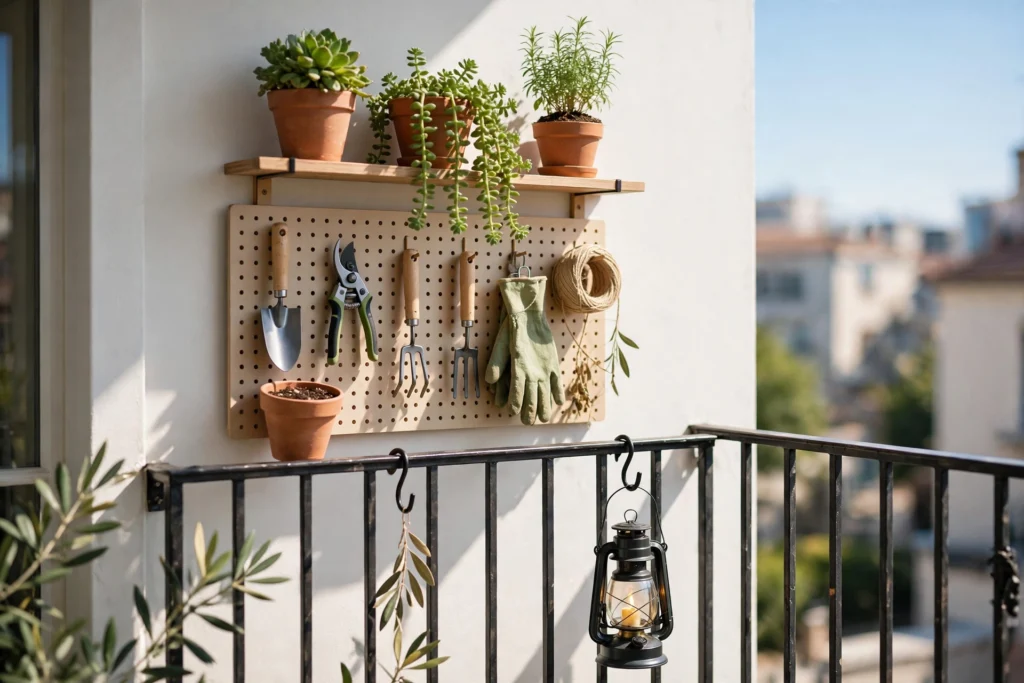
- Keep railing items light: stay under about ten pounds each unless your rail is rated for more. Heavy pots belong on the floor, not hanging over the edge.
- Use weatherproof hardware: stainless or powder-coated hooks and brackets, outdoor-rated screws, and no bare metal that will rust and stain the wall.
Two more rules keep the wall storage safe:
- Leave a clear walking line: at least three feet of open floor from the door to the railing. If you have to sidestep a pot to reach your chair, the zone is wrong.
- Check the wind: anything light enough to blow off the balcony is a safety problem, not storage. Tie down or weigh down anything that could lift in a gust, and never hang loose items from a railing.
A balcony that uses its walls feels bigger the same day you set it up. The floor opens up, the balcony plants move up where they get more light, and the chair you actually sit in finally has room around it. That is the quiet payoff of vertical storage: the balcony gets bigger without getting bigger.
Hidden Storage That Doubles as Furniture
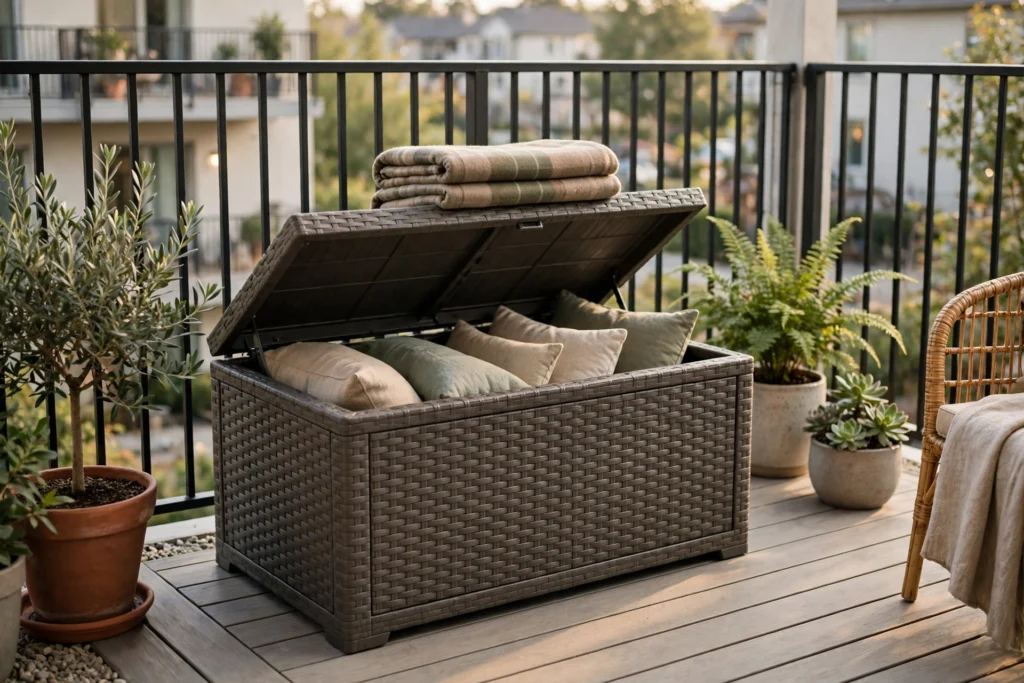
A deck box is the quiet hero of balcony organization ideas. A slim resin deck box holds cushions, a folded blanket, the watering can, and a bag of soil — and it doubles as a side table or an extra seat. A storage bench does the same job with a back to lean on. When storage is also furniture, it earns its floor space twice over, and the balcony never looks like a storage unit.
Pick the size by what needs to live inside, not by what looks good empty. A seventy-gallon box swallows a 25-pound bag of potting mix, two gallons of liquid feed, and a coiled hose with room to spare. A smaller bench box holds cushions and gloves and nothing else, which is fine — a box that is too big becomes a second junk drawer. Measure the spot first, then buy the box that fits it, not the other way around.
Keep airflow in mind. Do not seal damp items in an airtight box — airflow prevents mold, especially in winter. Let cushions and fabric dry before you store them, and use a waterproof liner for soil or tools so a leak never soaks the rest of the box. A small gap at the lid, or a box with built-in vents, is worth more than a perfect seal.
That is the simple test inside balcony organization ideas: pick up any item on the balcony and ask where it lives. If the answer is “inside the bench,” it has a home. If the answer is “on the floor next to the bench,” it does not have one yet, and the bench needs a quick sort. One box, one purpose, and the balcony stays calm.
Balcony Garden Storage
A balcony garden needs its own corner, and balcony organization ideas give it one. Garden supplies are the messiest things on a balcony — open bags of soil, seed packets, pruners, gloves, a watering can that drips — and they spread fast if they have no spot. Give them a corner, and the rest of the balcony stays clean.
Set up a small potting station against one wall: a narrow shelf for tools, a watertight bin for opened soil, and a hook for the watering can. Transfer opened potting mix into an opaque, watertight container as soon as you crack the bag — a twenty-gallon galvanized steel bin with a press-fit lid blocks UV, will not crack in the cold, and looks decent on a balcony. Keep seed packets in a small lidded box on the shelf, not loose in a drawer, so they stay dry and easy to find.
Group the plants by water need, not by looks. The thirsty herbs live together near the watering can, the drought-tolerant succulents live together where you will not overwater them by accident, and the tall plants go against the wall where the wind cannot knock them over. Railing planters hold the herbs you pick every day — basil, mint, parsley — because they get the most sun and they are right there when you cook.
Our small pantry organization ideas guide uses the same grouping rule for food — things used together live together — and it works for a balcony garden for the same reason. A garden that is grouped by need is easier to water, easier to feed, and easier to enjoy. That is the whole point of a garden corner: the work gets smaller, and the plants get bigger.
Weatherproof Bins for Cushions and Seasonal Gear
Cushions, blankets, and seasonal gear are the items that ruin a balcony when they have no home. Left out, outdoor cushions get wet, fade, and mildew. Stuffed in a corner, they block the walking line. The bins-and-boxes side of balcony organization ideas solves both problems at once: one weatherproof bin, one purpose, and the gear stays dry and out of the way.
Use bins made for outdoors: UV-treated canvas, resin, or powder-coated metal, with lids that close tight. Soft woven bins add texture without the visual weight of plastic crates, and they work well for blankets and cushions. Hard resin boxes work better for heavy or sharp items — tools, spare pots, the folding drying rack. Label the bins if you have more than two, so you never open three boxes to find the citronella candles.
Rotate with the seasons. In spring, the bin holds the winter covers and the heavy blankets. In summer, it holds the extra cushions and the outdoor games. In fall, it holds the summer cushions and the grill tools. One bin, swapped twice a year, keeps the balcony ready for the season you are actually in.
Small-Space Tricks That Really Help
Small-space balcony organization ideas matter most when the apartment balcony is four feet deep and the chair barely fits. The good news is that a small balcony does not need much furniture — it needs balcony furniture that folds, hangs, or hides.
Use foldable furniture. Two fold-flat chairs and a narrow bistro table give you a breakfast spot that vanishes in seconds when you need the floor. A wall-mounted drop-leaf table folds flat against the wall when you are done eating, if your building rules allow it and it is fixed safely. A folding chair hung on a sturdy hook takes up no floor at all.
Use the door and the corners. A slim rolling cart tucked against the railing holds the watering can, the gloves, and the seed box, and it pulls out when you need it and slides back when you do not. A dead corner holds a tall, narrow shelf or a stack of planters. A hanging shoe organizer on the balcony door holds small tools, clips, and gloves in clear pockets you can see into.
In a rental, none of this needs a drill. Command hooks, over-the-door organizers, freestanding shelves, and tension poles do the whole job without a single hole in the wall. Our rental friendly organization ideas guide has the full no-drill toolkit, and it works for a balcony just as well as it works for kitchens and bathrooms. That is the rule that makes these balcony organization ideas renter-friendly: nothing permanent, everything removable, and the deposit stays safe.
Your Balcony Reset Plan, Season by Season
Use this table to plan your balcony organization ideas in order. The heart of the system is doing the small jobs often, so the big job — a full balcony edit — only happens a few times a year.
| When | Job | What done looks like |
|---|---|---|
| One weekend | Balcony edit | Four piles sorted, keepers counted, rules checked |
| Same weekend | Zones set | Rail, wall, and floor zones marked, walking line clear |
| Every week | 10-minute tidy | Cushions in the box, tools back on hooks, floor swept |
| Every month | Bin check | Bins opened, damp items dried, labels still true |
| Every season | Full reset | Seasonal gear swapped, plants moved, one deep clean |
| Every year | Hardware check | Hooks, brackets, and shelves checked for rust and wear |
Our weekly cleaning schedule guide uses the same rhythm — small jobs often, big jobs rarely — and it works for a balcony for the same reason it works for the rest of the house. A system that asks for ten minutes a week will actually happen. A system that asks for a whole Saturday every month will not.
Frequently Asked Questions
How do I organize a very small balcony?
Start with the edit, then use the walls. That is where balcony organization ideas begin: remove everything you do not use weekly, put a slim shelf on the longest wall, hang the small tools on hooks, and keep the middle of the floor clear. Two fold-flat chairs and a narrow table give you a place to sit without eating the whole floor, and one deck box holds everything else. A four-by-eight balcony can hold a chair, a table, a garden corner, and storage — if nothing lives in the middle of the floor.
What storage works best on a rainy balcony?
Weatherproof storage: resin deck boxes, powder-coated metal shelves, and UV-treated canvas bins with lids that close tight. Avoid raw wood, untreated metal, and fabric bins with no cover — they warp, rust, and mildew in one season. Let cushions dry before you store them, and never seal damp items in an airtight box. The balcony organization ideas that survive rain are the ones built for rain: materials rated for outdoors, lids that close, and airflow so nothing stays damp.
Can I organize a balcony in a rental without drilling?
Yes, and most of it needs no drilling at all. Freestanding shelves with rubber feet, tension pole shelves, over-the-railing hooks, command hooks, and over-the-door organizers do the whole job without a hole in the wall. Check your lease first — some buildings limit what can attach to railings or how high storage can go — and keep everything removable. That is the rule inside balcony organization ideas for renters: if you cannot take it down in ten minutes, it does not belong on a rental balcony.
How do I keep a balcony organized all year?
Do ten minutes a week and one reset a season. The weekly tidy — cushions in the box, tools back on hooks, floor swept — stops the slow slide back to clutter. The seasonal reset swaps the gear, moves the plants, and catches the rust and wear before it becomes a repair. The habit matters more than the furniture: a balcony that gets ten minutes a week stays tidy, and a balcony with perfect shelves and no habit is a mess by spring.
Sit Outside More, Trip Over Less
You do not need a bigger balcony or fewer plants. A quick edit, zones for the rail, the wall, and the floor, a deck box that doubles as a seat, and ten minutes a week — do those four things and these balcony organization ideas will already feel different this weekend. The chair has room around it, the garden has a corner, and the floor is clear enough to walk barefoot. Start with the edit this Saturday. The first shelf can wait until next week.