
Bakeware storage ideas matter most on a Saturday morning, when you reach for one baking sheet and the whole stack of pans slides out of the cabinet with a crash. You wanted to bake cookies; instead you are on the kitchen floor, untangling a muffin tin from a cake pan while the oven beeps at an empty rack.
Bakeware is awkward in a way most kitchen gear is not. A baking sheet is wide and flat, a muffin tin is lumpy, a cake pan is round, and none of them nest neatly. Stack them and the bottom pan becomes impossible to reach. Line them up and they eat a whole cabinet. And the odd pieces — the cooling rack, the loaf pan you use twice a year, the pizza pan with the bent edge — drift to the back of the shelf and stay there. The fix is not a bigger kitchen. It is one honest sort, one upright system, and a zone for every shape. These bakeware storage ideas work whether you bake once a week or once a season, and the quick reset at the end keeps them working.
Sort Your Bakeware Before You Store Anything
You cannot organize bakeware while half of it is still scattered across cabinets, the oven drawer, and the shelf above the fridge. Pull every piece out onto the counter and look at what you actually own. Most kitchens find two baking sheets that are the same size, a muffin tin with one rusty cup, a cake pan from a set that lost its partner, three cooling racks, and a baking pan nobody remembers buying.
Sort what is on the counter into three groups. The first group is everyday: the baking sheet you reach for every week, the muffin tin that actually gets used, and the cake pan for birthdays. The second group is seasonal: the holiday cookie sheet, the roasting pan, and the specialty pans tied to one time of year. The third group is the let-go pile: warped pans, rusted tins, scratched nonstick, and duplicates of a size you already own twice. That count is the whole point of bakeware storage ideas — the system fits the pans you actually bake with, not the ones you wish you baked with.
Be strict with the let-go pile. A warped baking sheet that rocks on the oven rack is not going to fix itself, and a rusted muffin tin is taking the slot of a pan you would actually reach for. Good bakeware storage ideas start with owning less, so recycle the ruined pieces, donate the good spares, and keep only the bakeware that earns its space.
File Baking Sheets Vertically, Never Stack Them
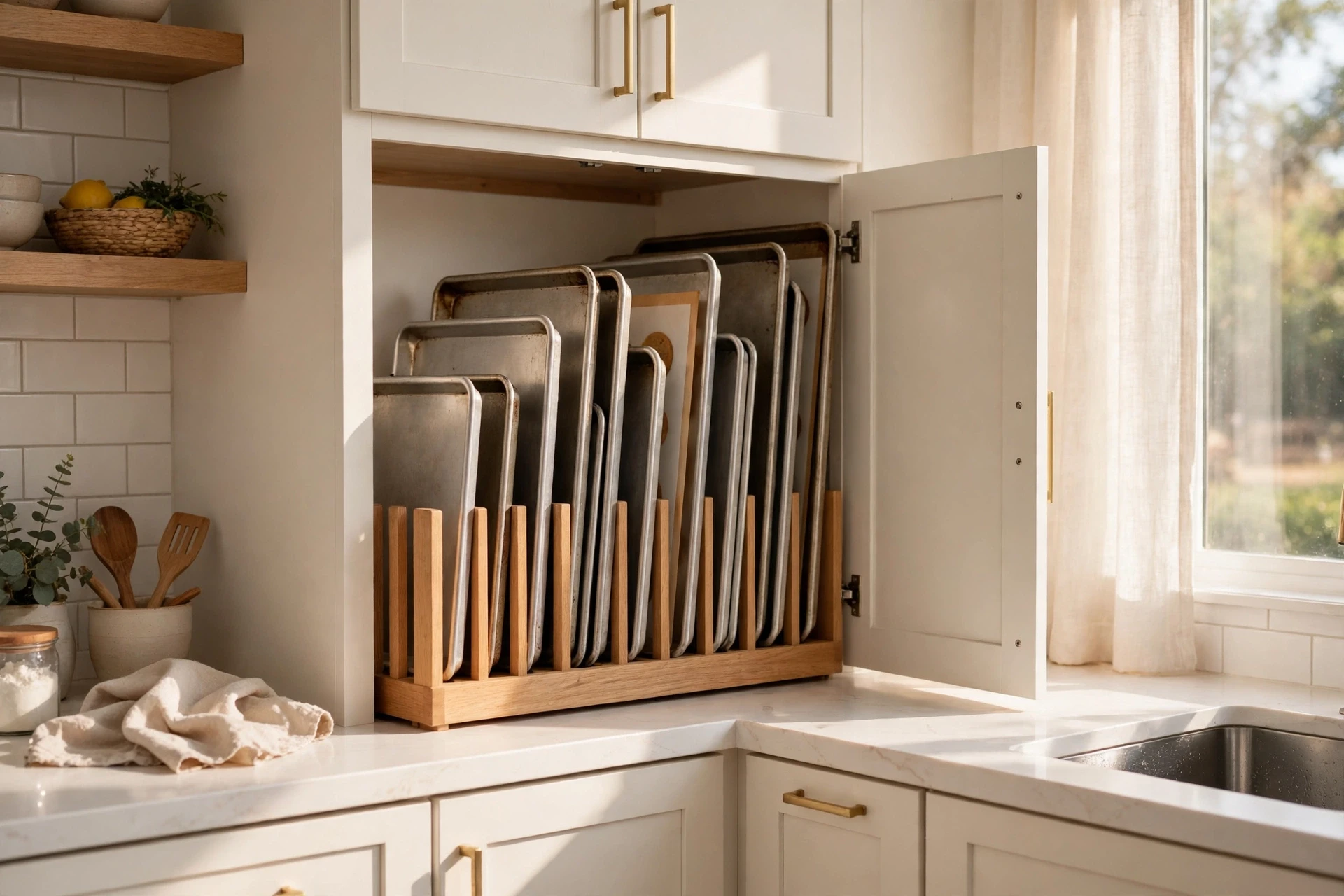
Stacking is the habit that ruins bakeware storage. Every time you need the bottom pan, you lift the whole pile, and every lift scratches the pan below it. The pans slide, the stack leans, and the one you want is always at the bottom. Filing pans upright is the single best of all the bakeware storage ideas for flat pieces, because each pan slides out on its own like a file from a drawer, and nothing else moves.
Filing is simple. Stand each baking sheet on its long edge, rim down, in a row inside the cabinet, with a little space between pieces so they do not rub. A cookie sheet files just as well as a full baking sheet, and a pizza pan slides into the same row. The row takes up one narrow slice of cabinet width, and you can see every pan at a glance, which beats digging through a stacked pile every time.
For pans you use every week, vertical filing beats stacking so clearly that most people never go back. You pull out one sheet, the rest stay put, and the cabinet stays quiet. Public Storage’s guide to storing baking sheets walks through the same clean-and-dry-first rule if you want a second opinion before you file a pan away for a season.
Dividers That Turn a Deep Cabinet Into Slots
A row of upright pans still needs something to hold it up, and that is where dividers earn their keep. A vertical divider is a simple upright panel — wood, metal, or plastic — that turns one wide cabinet into a set of narrow slots, one pan per slot. No drilling, no screws, no built-in work: a freestanding pan organizer drops into the cabinet and the job is done.
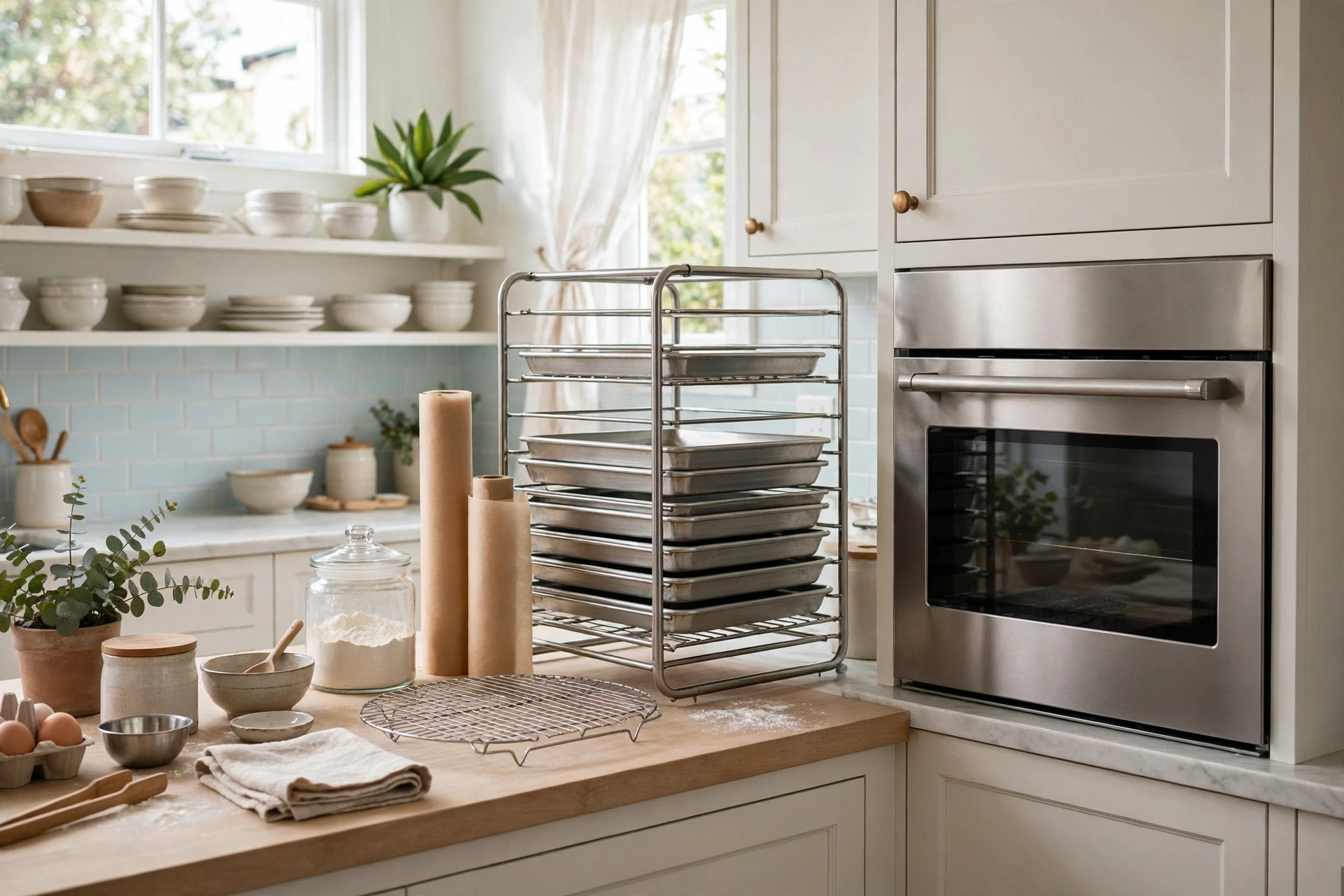
Give each slot one job. One slot for the big baking sheet, one for the cookie sheet, one for the cooling rack, one for the pizza pan. A sheet pan rack does the same work in a deeper cabinet, and a tension rod across a short cabinet makes a cheap divider in a rental where you cannot install anything. The cutting board storage guide uses the same upright rule for boards, and the two systems sit side by side in one cabinet without fighting each other.
Measure before you buy anything. The inside height of the cabinet decides which pans fit upright, and most standard cabinets take a half-sheet pan standing on edge with room to spare. A divider that is too tall for the shelf is useless, and a slot that is too tight scratches the pan every time you pull it out. Buy the divider after the sort, not before, so the slots match the pans you actually kept — the best bakeware storage ideas fit the pans, not the other way around.
Muffin Tins, Cake Pans, and Loaf Pans Get Their Own Zone
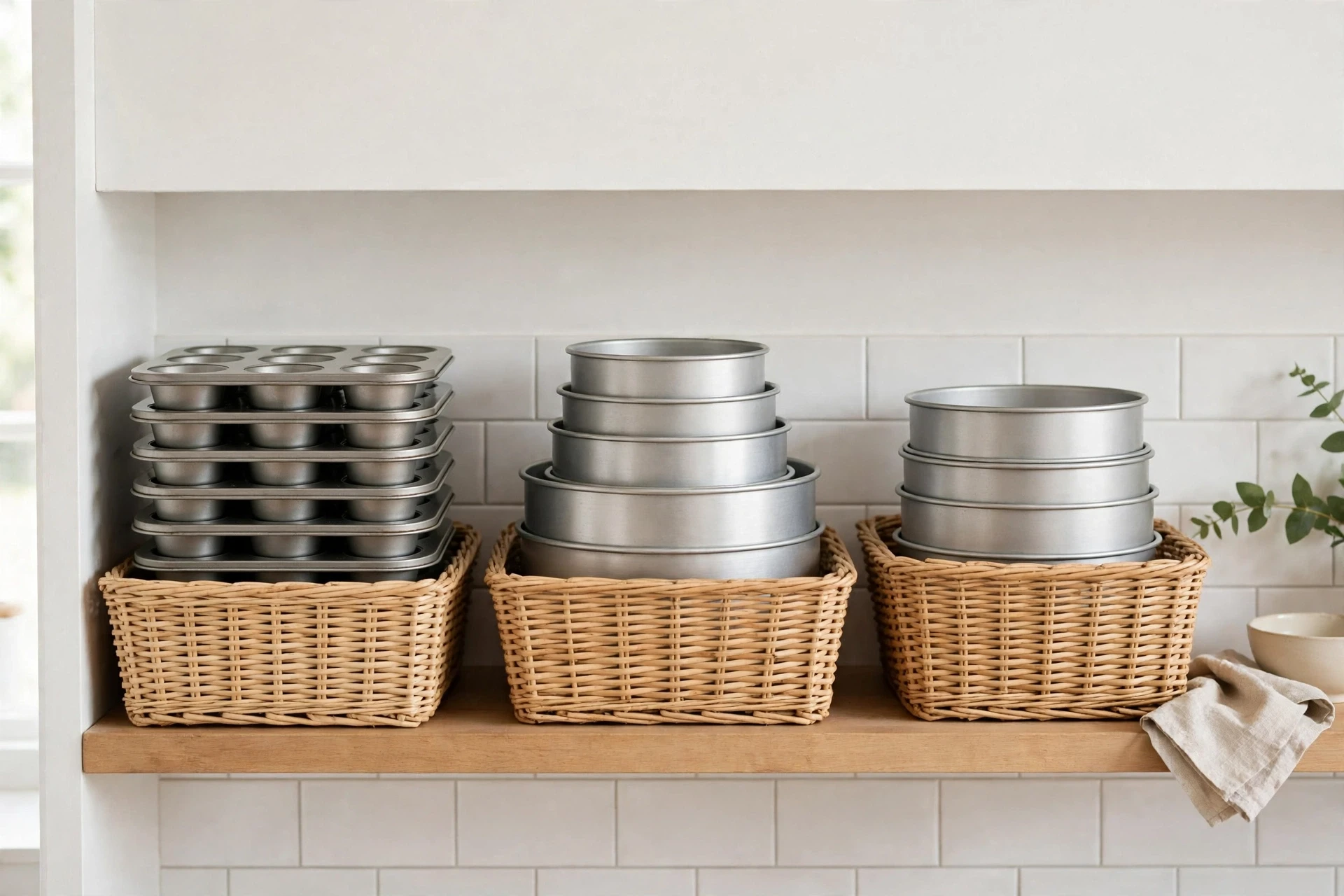
Flat pans file upright. Lumpy pans do not, and that is why muffin tins and cake pans need their own zone. A muffin tin cannot stand on edge, and a round cake pan rolls sideways in a slot, so give them a shallow bin or a short shelf of their own, stacked by shape, with the most-used piece on top.
Stack like with like and nothing else. Muffin tins stack together, cake pans stack together, and loaf pans stack together, with a sheet of parchment paper between nonstick pieces so the coating does not scratch. Keep the stack low — three pieces at most — so the bottom pan is still easy to reach. A lid rack turned on its side makes a handy divider for a stack of round pans, holding each one in its own lane inside a bin.
Keep the odd shapes in the same zone so the whole baking family lives together. The bundt pan, the springform pan, and the pie dish go in one bin, labeled, on the shelf above or below the flat pans. One zone for all the bakeware means you stop hunting through three cabinets when a recipe calls for two different pans, and that single zone is one of the simplest bakeware storage ideas for a mixed collection.
Lids, Racks, and the Small Stuff
The small pieces are what turn a tidy cabinet back into a junk pile. A wire cooling rack slides behind the pans, a silicone mat curls up and vanishes, and the parchment paper box ends up in a different drawer from the pans it serves. Give the small stuff a home inside the bakeware zone instead of letting it drift.
Cooling racks file upright in the same divider row as the baking sheets — they are flat, they stand on edge, and they slide out one at a time. Roll each silicone mat loosely and stand it in a tall jar or a narrow bin beside the pans, never folded tight, so it unrolls flat when you need it. Keep the parchment paper box, the cupcake liners, and the pastry brush in one small basket on the same shelf as the muffin tins, so the baking supplies sit with the pans they serve.
The rule for small pieces is simple: if it touches the bakeware, it lives with the bakeware. A basket that holds the parchment paper and the liners next to the muffin tin saves a trip across the kitchen every time you bake, and it is one of the quiet bakeware storage ideas that saves the most time — it stops the small stuff from scattering into every drawer in the room.
Build a Baking Station Near the Oven
A zone becomes a baking station when it sits near the oven and holds everything a bake needs in one reach. Put the flat-pan divider in the cabinet closest to the oven, the muffin-tin bin on the shelf above it, and the small basket of parchment paper and liners right beside them. The measuring cups and the mixing bowls go in the same corner if you have the room, and the whole setup stays within a few steps of the oven door.
The same zone rule works across the kitchen — the water bottle storage ideas guide groups bottles the same way, by use and by reach, and the baking station is the same idea applied to pans. Everyday pans live at waist height, where you can grab them without stretching or stooping. Seasonal pans go up high or down low, where they are out of the daily path but easy to reach when the holidays come.
A station also makes cleanup faster. When the pans are done, they go back to their own slots instead of landing in a pile on the counter, and the next bake starts from a tidy cabinet instead of a mess. That is the real payoff of bakeware storage ideas that are built around how you actually bake, not around how a catalog photo looks.
Pick the Right Storage for Your Bakeware
Not every method fits every pan, so match the storage to the shape and how often you use it — these bakeware storage ideas are a menu, not a shopping list.
| Storage method | Best for | Watch out for |
|---|---|---|
| Vertical divider slots | Baking sheets, cookie sheets, cooling racks | Measure cabinet height first |
| Freestanding pan organizer | Renters, deep cabinets, no drilling | Slots must fit your widest pan |
| Shallow bin by shape | Muffin tins, cake pans, loaf pans | Keep stacks to three pieces |
| Sheet pan rack | Large collections, pull-out shelves | Needs a deep cabinet |
| Under-oven drawer | Flat pans, pizza pans, spare sheets | Check it is clean and dry first |
| Labeled bin for small pieces | Parchment paper, silicone mats, liners | Keep it on the same shelf as the pans |
Vertical filing wins for most kitchens because it is fast, cheap, and kind to the pans. The bin is the best upgrade for lumpy pieces like muffin tins, and the under-oven drawer is the best free space most kitchens already own and never use. Pick one method for the flat pans and one for the lumpy ones, and stop buying organizers until the first one is full.
Keep It Working With a Quick Reset
Bakeware stays organized only if someone checks it when the cabinet starts to drift. Build a short reset into the same day you do your weekly cleaning schedule, once a month, and the pan cabinet never gets bad enough to need another big sort:
- Pull out every pan, wipe the shelf, and check for warping, rust, or scratched nonstick before it goes back.
- Re-file any pan that has been stacked flat, and put the parchment paper back between nonstick pieces.
- Wash the seasonal pans before they go back into storage, and let them dry fully first.
- Check the labels — one pan per slot, and the label still matches what is inside.
- Move any pan nobody used this month to the let-go pile, and note which sizes you actually reach for.
Five minutes a month is all it takes, and it is the habit that turns a one-time tidy-up into bakeware storage ideas that still work a year from now.
Frequently Asked Questions
What is the best way to store baking sheets so they do not scratch?
File them upright with a little space between pieces, or put a sheet of parchment paper between them if they must stack. Upright filing is the simplest of all the bakeware storage ideas for scratch control, because the pans never slide across each other, and each one comes out without touching the rest.
Should I store muffin tins stacked or on their side?
Stack them, but only with like pieces and only three high, with parchment paper between nonstick tins. A muffin tin cannot stand on edge the way a baking sheet can, so a shallow bin with a low stack is the best home for it. Keep the stack low enough that the bottom tin is still easy to lift out.
How do I store bakeware in a small kitchen with no spare cabinet?
Use the under-oven drawer for flat pans, and one narrow cabinet with a freestanding pan organizer for the rest. A tension rod across a short cabinet makes a cheap divider, and a single labeled bin on a high shelf holds the seasonal pans. The best bakeware storage ideas for small kitchens all use height and upright filing, not more cabinets.
How should I store bakeware I only use at the holidays?
Wash it, dry it fully, and file it upright or stack it with parchment paper between pieces in a labeled bin on a high shelf. Check it once a season, wipe the shelf, and it will come out looking the way it went in. A clean, dry pan stored upright costs nothing, and a damp one stored in a stack costs you the pan.
A Quiet Cabinet That Is Ready to Bake
A good bakeware setup does not make you think. You reach for the sheet, it slides out on its own, and the oven is ready before the dough is. That is what good bakeware storage ideas buy you — a kitchen that is ready to bake on a busy evening instead of fighting you. Start tonight: pull the pans out, keep the ones you actually use, file the flat ones upright, bin the lumpy ones by shape, and label every slot. One small sort turns a noisy pile into a system that works — and it stays that way with five minutes a month.