

Advent calendar organization ideas solve the December scramble that hits every family with a reusable calendar: it is November 28, the calendar is still in a box, nobody remembers where the fillers went, and the first door is supposed to open in three days. A calendar that lives in a tangle of bags and half-bought treats turns a sweet daily ritual into a nightly hunt, and by December 10 the drawers are empty because the filling never caught up. The fix is a small system, set up once in November, that carries the whole countdown on its own. These advent calendar organization ideas cover the calendar itself, the fillers, the daily routine, and the January pack-away, so the countdown feels calm instead of chaotic.
Most Christmas countdown calendars fail on the same two points: the pockets are the wrong size for the treats, and nobody planned the 24 fillers ahead of time. A wooden drawer that holds one chocolate will not hold a small toy, and a fabric pocket made for a note will not hold a bath bomb. Picking the calendar to match the fillers, instead of the other way around, is the first move in advent calendar organization ideas, and it saves the whole month. The second move is a master list made in one sitting: 24 days, 24 fillers, all bought and bagged before December starts, so no evening ends with a parent digging through drawers at 10 p.m.
You will learn how to pick a reusable advent calendar that fits what you actually want to put inside it, fill it with ideas for kids, teens, and adults without blowing the budget, set up a countdown station that stays tidy all month, prep all 24 fillers in one afternoon with a simple master list, and store the calendar after Christmas so it comes out ready next year. By the end of this guide, you will have advent calendar organization ideas that turn the countdown into the easiest part of December, not the most stressful.
Pick the Right Calendar Before You Fill Anything
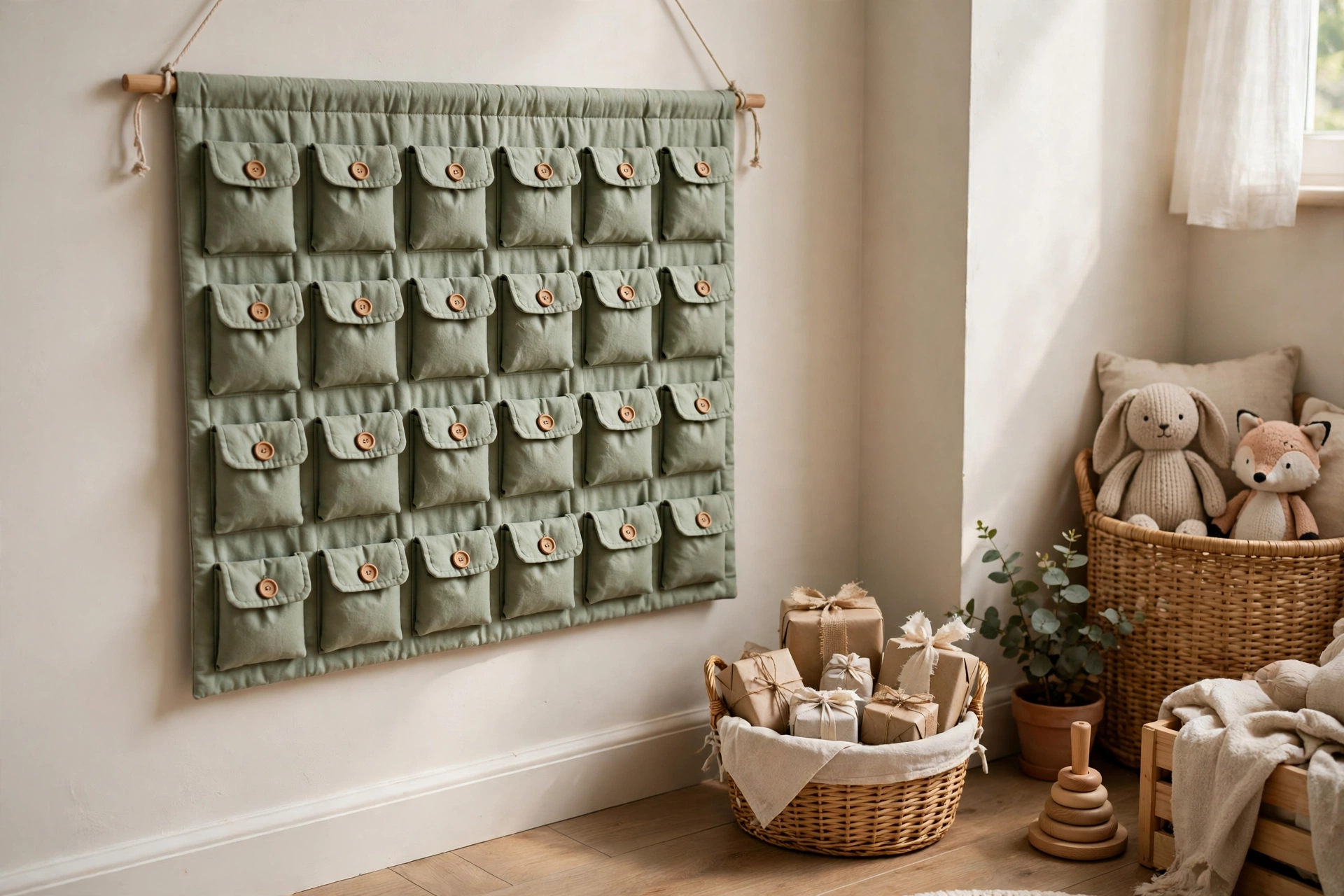
Start with the calendar, not the treats. A reusable advent calendar comes in four main shapes, and each one suits a different kind of filler. Wooden calendars with little drawers or doors look beautiful on a mantel and last for years, but the compartments are small — one chocolate, a folded note, a tiny figure, not much more. A fabric advent calendar with numbered pockets holds more, folds flat for storage, and hangs on a wall or a door, which makes it the best pick for families filling for two or three kids.
Box calendars with 24 small boxes or bags give you the most room and suit bigger fillers like socks, small books, or craft kits. Paper envelope calendars cost almost nothing and work well for notes, activity cards, and flat surprises. A fillable advent calendar — any calendar you fill yourself — works best when the display suits the room: a wooden house on the mantel, a fabric hanging on the door, or a basket of bags on the sideboard. Matching the calendar to the fillers is the heart of advent calendar organization ideas, because a filler that does not fit the pocket is a filler that never gets used.
| Calendar type | Best for | Pocket size | Storage in January |
|---|---|---|---|
| Wooden with drawers | Small treats and notes | Small — one chocolate or a folded note | Wrapped in a towel, on a shelf |
| Fabric with pockets | Families filling for kids | Medium — small toys and treats | Folds flat in a drawer |
| Box or bag set | Bigger fillers, mixed ages | Large — socks, books, craft kits | Boxes nest inside each other |
| Paper envelopes | Notes and activity cards | Flat only — cards and photos | Recycle or keep flat in a folder |
Use the table to match the calendar to the fillers before you buy anything — it is the quick map for advent calendar organization ideas in any home.
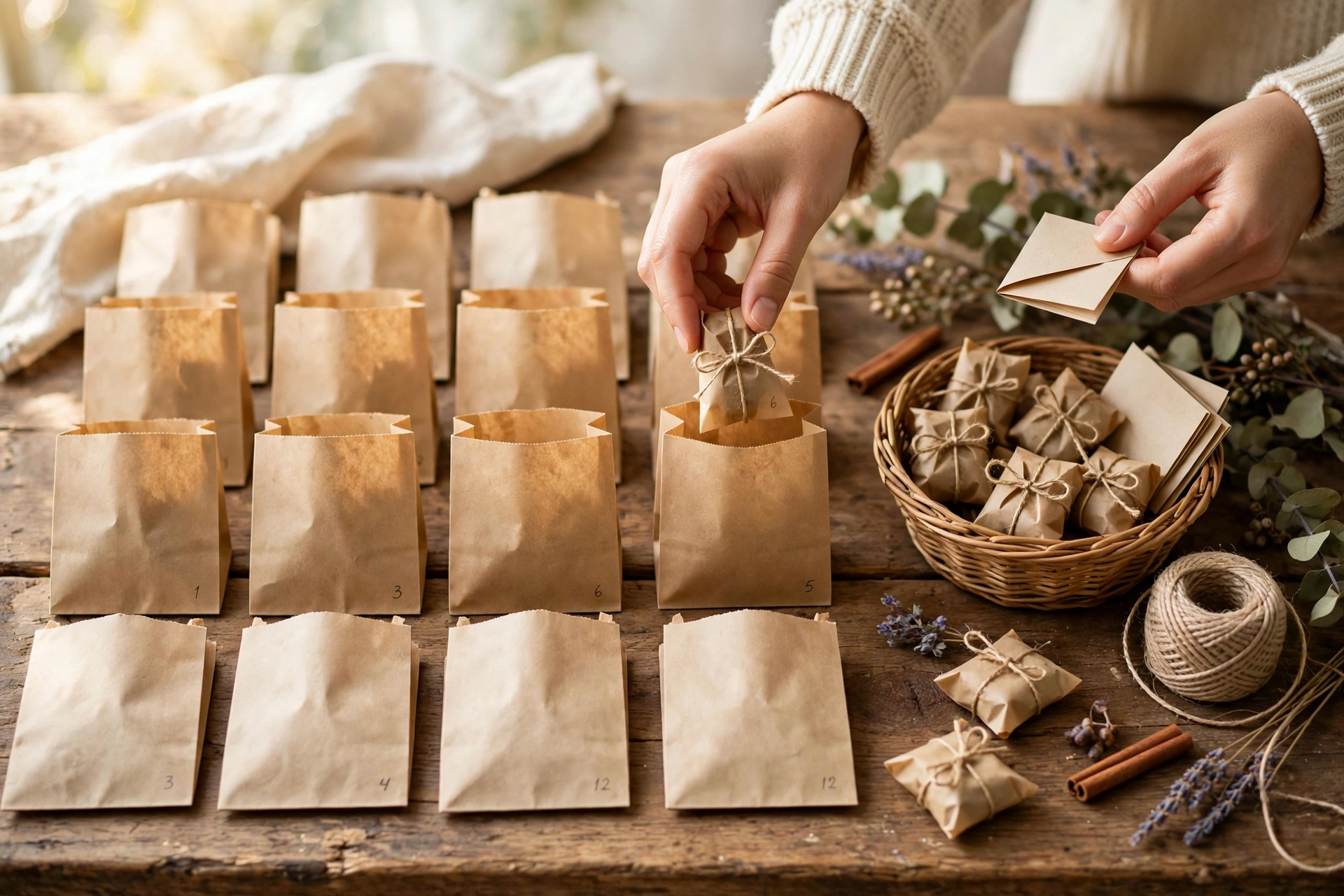
Measure the pockets before you buy anything to go inside them. A wooden drawer is often only two inches wide, and a fabric pocket might be four inches deep. Take a ruler to the calendar, write down the width, height, and depth of one compartment, and carry those numbers when you shop for fillers. A small toy that looks tiny in the shop can still be too wide for the drawer, and a bath bomb that fits the pocket dry may not fit once it is wrapped. Measuring first is one of the simplest advent calendar organization ideas, and it stops the most common December frustration: a pile of fillers that do not fit anywhere.
Think about who the calendar is for before you choose the style. A calendar for a toddler needs big pockets, soft fillers, and a display low enough for small hands to reach without climbing. A calendar for a teen can use small drawers and grown-up fillers like lip balm, earbuds, or gift cards.
A calendar for the whole family works best as a fabric hanging or a set of numbered bags, because the pockets are big enough for a mix of treats and activity cards. One calendar per person sounds generous, but one shared family Christmas advent calendar with a mix of fillers is easier to keep filled and far less to store in January. That is advent calendar organization ideas in one choice: one calendar, the right size, filled for the people who will actually open it.
If you already own a calendar, work with what you have instead of buying another one. A wooden calendar with tiny drawers still works if you fill it with notes that point to a bigger surprise hidden elsewhere in the house. A fabric calendar with deep pockets can hold a small toy one day and a treat the next. The calendar you own is the right calendar once you match the fillers to it, and the money you save goes toward better fillers. These advent calendar organization ideas work with any calendar you already have, as long as you measure the pockets first and plan the fillers to fit.
Fill It by the Week: Filler Ideas for Kids, Teens, and Adults
The easiest way to fill 24 days without running out of ideas is to think in weeks, not days. Give each week a theme, and the advent calendar filler ideas pick themselves. Week one can be treats: small chocolates, candy canes, fruit snacks, and a few wrapped sweets. Week two can be small toys and playthings: a tiny figure, a bouncy ball, a sticker sheet, a hair clip, or a small car.
Week three can be activities: a card that says “bake cookies together,” “watch a Christmas movie,” or “build a snowman if it snows.” Week four can be notes and keepsakes: a handwritten note, a photo, a joke, or a small ornament for the tree. Four themes, six days each, and the calendar fills itself — that is the weekly rhythm behind advent calendar organization ideas, and it keeps the countdown varied instead of 24 days of the same chocolate.
For kids, mix the fun with the useful. A small pack of crayons, a tiny notebook, a pair of fun socks, a bath crayon, or a puzzle piece that builds into a picture over the month all fit a pocket and feel like a real surprise. Keep the sugar to about a third of the days, because 24 days of chocolate gets old fast and the calendar stops feeling special. A small toy every few days, a treat on the weekends, and an activity card on the busy weekdays is a mix that holds a child’s attention all month. An advent calendar for kids works best when the fillers match the child’s age, so check the pocket size against the filler before you buy, and keep anything small enough to swallow out of a toddler’s calendar entirely.
For teens, think small, useful, and a little bit grown-up. Lip balm, a phone sticker, a hair tie, a small candle, a tea bag, a gift card for a coffee, or a note with a compliment all fit a drawer and feel personal instead of childish. A teen who would roll their eyes at a chocolate coin will open a drawer for a five-dollar gift card or a card that says “movie night, your pick.” If you want more ideas for filling a calendar for an older kid or an adult, our guide to a fill-your-own advent calendar from Mums Make Lists walks through the same plan — budget, container, and filler mix — with a clear step-by-step for first-timers. That mix of treats and small luxuries is what makes advent calendar organization ideas work for teens: the filler feels chosen for them, not bought in bulk.
For adults, the calendar can be a small daily treat of its own. A single tea bag, a chocolate truffle, a mini candle, a bath soak, a small bottle of hand cream, or a note with a date-night idea all fit a drawer or a pocket. A couple’s calendar can alternate: one day a treat for one person, the next day a treat for the other, with a shared activity card on Sundays. An advent calendar for adults does not need to cost much — a bag of good tea, a box of truffles split across 24 days, and a stack of handwritten notes will fill a calendar for less than the price of a shop-bought one, and it will feel far more personal. The same rule applies to every age: the filler should fit the pocket, suit the person, and cost less than the joy it brings.
Set Up a Countdown Station That Stays Tidy All Month
A calendar needs a home for December, and the best spot is one you can see every morning without it getting in the way. A fabric calendar hangs on a wall hook, a door, or a banister, where it is visible and out of the reach of pets. A wooden calendar sits on a mantel, a sideboard, or a shelf, where it looks like part of the decorations instead of clutter. Whatever the shape, an advent calendar display works best at eye level, where the numbers are easy to read and the doors are easy to reach.
Keep the fillers close to the calendar, not in a different room. A small basket or a labeled box beside the calendar holds the spare fillers, the activity cards, and the notes for the days ahead, so refilling a drawer takes ten seconds instead of a trip to the cupboard. If your calendar is the kind you fill all at once in November, the basket holds the extras: the backup treats for the days you miscounted, the spare batteries for a light-up calendar, and the notes you wrote but have not used yet. One basket, one spot, and the calendar stays full all month. Our small kids room organization ideas guide uses the same one-basket rule for toys, and it works just as well for a December countdown.
Make the station safe for little hands. Hang a fabric calendar at a height a child can reach without standing on a chair, and keep a wooden calendar on a low, stable shelf instead of a high mantel where a child will climb to reach it. Keep small fillers in the higher pockets and bigger, safer fillers in the lower ones if a toddler shares the calendar with an older child. A calendar that a child can open safely on their own is a calendar that becomes their morning ritual, and that is the point of the whole countdown. Safety is part of advent calendar organization ideas, not an afterthought, because a daily ritual should never need a rescue.
Add a small ritual to the station and the countdown becomes a habit. A tiny bell, a special mug for hot chocolate on Sunday mornings, or a card that says “today’s surprise is in the kitchen” turns the opening into a moment instead of a grab-and-go. Keep a pencil and a small notepad at the station so anyone can jot down a filler idea for next year while they remember it. The station is the heart of advent calendar organization ideas for a family, because the calendar is not just a decoration — it is the first thing the kids run to in the morning, and it deserves a spot that says so.
Prep All 24 Fillers in One Afternoon
The single best move in advent calendar organization ideas is a master list made before you buy anything. Take a sheet of paper or a note on your phone and write 24 lines, one for each day from December 1 to December 24. Next to each day, write the filler, where it is stored, and whether it needs any prep. A line that says “Dec 7 — sticker sheet — in the filler basket — none” takes five seconds to write and saves a frantic evening later. Make the list first, then shop from it, and you will not buy a second set of fillers because you forgot what was already in the bag.
Buy the fillers in one trip if you can, and bag them the same afternoon. Lay out 24 small bags or envelopes, number them 1 to 24, and drop one filler into each bag as you go. A numbered bag is faster than a drawer to fill, and it lets you check at a glance which days are done and which are still empty. If a filler is too big for its bag, swap it now, while the shops are still open, instead of discovering the problem on December 18. Bagging in one afternoon is the most practical of all advent calendar organization ideas, because the whole month is done before December starts and the only daily job is opening the door.
Label the bags with the day number in big, clear writing, and keep them in date order in one box or basket. A shoebox with dividers, a small crate, or a zip bag with the numbered bags inside all work, as long as the bags stay in order and the box stays in one place. If you fill the calendar all at once, the box holds the spares and the notes. If you fill it a week at a time, the box is the calendar’s supply cupboard, and each advent calendar refill takes five minutes on a Sunday night. Either way, one box, numbered bags, date order — that is the system that keeps advent calendar organization ideas working when December gets busy.
Set a budget before you shop, and stick to it. A calendar filled with small treats, notes, and activities can cost less than twenty dollars, while a calendar filled with a small toy every day can cost five times that. Decide the total first, divide it by 24, and shop to that per-day number. A two-dollar filler feels generous when it is chosen well, and a ten-dollar filler feels wasteful when it does not fit the pocket. A budget is part of advent calendar organization ideas because the countdown should be a joy, not a bill, and a calendar that costs less than the shop-bought version is a calendar you will happily fill again next year.
Store Your Reusable Calendar After Christmas
January is when a reusable advent calendar earns its keep or gets ruined, and good advent calendar storage is what decides which one it is. A wooden calendar needs a dry spot, wrapped in a towel or an old sheet so the drawers do not rattle and chip. A fabric calendar folds flat, but it should be folded loosely, not creased hard, so the advent calendar pockets keep their shape, and stored flat in a drawer or on a shelf where nothing heavy sits on top of it. A box calendar stacks neatly if the boxes are empty and nested, and the numbered bags can be washed or wiped and stored inside the biggest box. The way you pack the calendar away decides whether it comes out looking new next December or comes out broken, and that is why advent calendar organization ideas include the pack-away, not just the countdown.
Label the storage box before you put it away. A box that says “Advent calendar — wooden house, 24 drawers, fillers in the red bag” is a box you will find in November without opening five others. Put the filler list from this year inside the box too, so next November you can see what worked, what did not fit, and what the kids loved. A note that says “Dec 12 — the bath bomb was too big for the drawer” is worth more than a new calendar, because it stops the same mistake next year. Labeling the box is one of the quietest advent calendar organization ideas, and it is the one that saves the most time twelve months later.
Keep the calendar with the rest of the Christmas decorations, not in a random cupboard. A shelf, a labeled bin, or a bag with the Christmas lights and ornaments is the right home, because the calendar comes out at the same time as the rest of the decorations and goes back with them. If the calendar lives with the Christmas things, it will not be forgotten in a bedroom cupboard, and it will not be mistaken for a toy box in June. Our holiday card organization ideas guide uses the same rule for cards: one labeled box, stored with the season it belongs to, so nothing gets lost between Decembers. Store the calendar with its season, and it will be there when the season comes back.
Check the calendar when you pack it away, not when you take it out. A loose drawer, a torn pocket, or a missing number tag is a five-minute fix in January and a frustrating hunt in November. Fix the pocket now, replace the tag now, and write the fix on the label so you remember it. A calendar that is checked and fixed in January is a calendar that opens cleanly on December 1, and that small check is the last step in advent calendar organization ideas for the year. The calendar you pack away with care is the calendar you will love opening next year.
The Two-Minute Daily Ritual That Keeps It Going
A countdown only works if someone opens the door every day, and the easiest way to make that happen is a tiny daily ritual. Open the door at the same time each day — with breakfast, after school, or before bed — and make it the same moment every day so nobody has to remember. A calendar opened at breakfast is a calendar that never gets forgotten, because breakfast happens every day. A calendar opened “whenever” is a calendar with three doors opened on Sunday night to catch up, and the magic is gone. That daily habit is the core of holiday countdown organization: the calendar only works if the door opens.
Keep the ritual short. Open the door, take out the filler, read the note or eat the treat, and put the drawer or pocket back in place. Two minutes, no more, and the calendar is ready for tomorrow. If the filler is an activity card, read it together and decide when it happens, then put the card on the fridge so it does not get lost. If the filler is a treat, eat it now instead of saving it in a pocket where it melts or gets crushed.
A two-minute ritual is easy to keep for 24 days, and a ritual that is easy to keep is a ritual that actually happens. That is advent calendar organization ideas at their simplest: same time, same spot, two minutes, every day.
Let the kids own the opening. A child who opens their own door every morning feels the countdown in a way a parent opening it for them never will. If two kids share a calendar, alternate the days — one opens the odd days, the other opens the even days — and write the names on the master list so there is no argument.
Advent calendar ideas for adults work the same way: the ritual is a quiet moment with a cup of tea and a small treat before the day starts. Whoever opens the door, the ritual belongs to them, and the calendar becomes their countdown. Advent calendar organization ideas work best when the person who opens the door is the person the calendar was made for.
If you miss a day, do not try to catch up all at once. Open yesterday’s door and today’s door, enjoy both fillers, and carry on. A missed day is not a failed countdown, and opening three or four doors at once turns a daily joy into a chore. The calendar is there to make December feel slower and sweeter, not to add another thing to feel behind on. That is the kindest of all advent calendar organization ideas: the countdown bends so the family does not have to.
Advent Calendar Organization Checklist
Run through this list in November, and these advent calendar organization ideas will carry the whole countdown.
- Measure the calendar pockets or drawers before buying fillers
- Pick one calendar that fits the people opening it, not one per person
- Write the master list: 24 days, 24 fillers, storage spot, prep needed
- Set a total budget and a per-day number, then shop from the list
- Bag and number the fillers 1 to 24 in one afternoon, in date order
- Choose the countdown station spot once and do not move it
- Keep a basket of spares, notes, and activity cards beside the calendar
- Hang or place the calendar where kids can reach it safely
- Open one door a day at the same time, two minutes, every day
- Pack the calendar away in January, labeled, with the filler list inside
Frequently Asked Questions
When should I start organizing my advent calendar?
Start in mid-November, about two weeks before December 1. That gives you time to pick or check the calendar, measure the pockets, make the master list, and buy the fillers in one trip without rushing. A calendar organized in mid-November is a calendar that opens smoothly on December 1, while a calendar started on November 30 is a calendar filled with whatever was left in the shops. If you already own a reusable calendar, the same two weeks is enough to check it, fix any loose pockets or drawers, and fill it at a calm pace. Our christmas card organization ideas guide follows the same mid-November timing, because the whole holiday season runs better when the paper and the presents are sorted before December starts.
What do you put in a reusable advent calendar?
Fill it with a mix: about a third treats, a third small useful things, and a third notes or activities. Treats can be small chocolates, candy canes, or fruit snacks. Useful fillers can be stickers, hair clips, socks, lip balm, a tea bag, or a small toy. Notes and activities can be a joke, a compliment, a photo, or a card that says “bake cookies together” or “movie night, your pick.” The mix matters more than the price: a calendar with 24 different little surprises feels generous, while a calendar with 24 of the same chocolate feels flat by week two. Check the pocket size first, because the best filler in the world is useless if it does not fit the drawer.
How do I store a reusable advent calendar after Christmas?
Clean it, fix it, label it, and store it with the rest of the Christmas decorations. Empty every pocket and drawer, wipe the calendar down, and fix any loose pocket, torn tag, or wobbly drawer before you pack it away. Fold a fabric calendar loosely and store it flat, wrap a wooden calendar in a towel so the drawers do not chip, and nest box calendars inside each other. Label the storage box with what is inside — “wooden advent calendar, 24 drawers, filler list in the red bag” — and put this year’s master list inside the box so next November you know what worked. A calendar stored with care comes out ready next December.
Can I make my own advent calendar instead of buying one?
Yes, and a DIY advent calendar is often the cheapest way to get exactly the pockets you want. Numbered paper bags in a basket, envelopes pegged along a string, a shoebox with 24 numbered packets, or folded paper pockets on a board all work, and each one costs almost nothing. The key is the same as with a bought calendar: measure the pocket first, make the master list, and bag the fillers in date order before December starts. A homemade calendar also lets you choose the size of every pocket, so a bigger filler is never a problem. If you want a step-by-step plan for a fill-your-own calendar, the Mums Make Lists guide to making one covers the budget, the container, and the filler mix in clear detail.
Start in November, Enjoy December
An advent calendar does not need to cost much, and it does not need to be perfect. It needs pockets that fit the fillers, a master list made before December, a spot that stays put all month, and a two-minute ritual that opens one door a day. Measure the calendar, fill it by the week, set up the station, and pack it away with a label in January. That is what advent calendar organization ideas are for: a countdown that feels calm, not chaotic, and a calendar that comes out ready next year.
These advent calendar organization ideas will not make December quiet — but they will make the countdown the easiest part of it, and they will give your family a small daily moment that belongs to them. That is what a good countdown does: it slows December down, one little door at a time. Start in mid-November, fill it in one afternoon, and let the calendar do the rest.