
VHS storage ideas are what stand between your family movies and a box of tapes nobody can play anymore. The tapes are still in the house — in a closet, on a shelf, in a box in the spare room — but nobody knows which tape holds the birthday party, which one is blank, and which one has been sitting in a damp corner for ten years. The VCR is long gone, the labels are faded, and every year the tapes sit there, the picture inside them gets a little weaker.
The trouble with VHS is that it does not wait. The tape inside each cassette is magnetic, and it slowly loses its grip on the picture whether you play it or not. Heat speeds that up. Damp speeds it up more.
A stack of tapes lying flat in a hot attic can turn a clear home movie into snow and squeal in a few summers. That is the honest part, and it is why the tapes need a plan now, not someday.
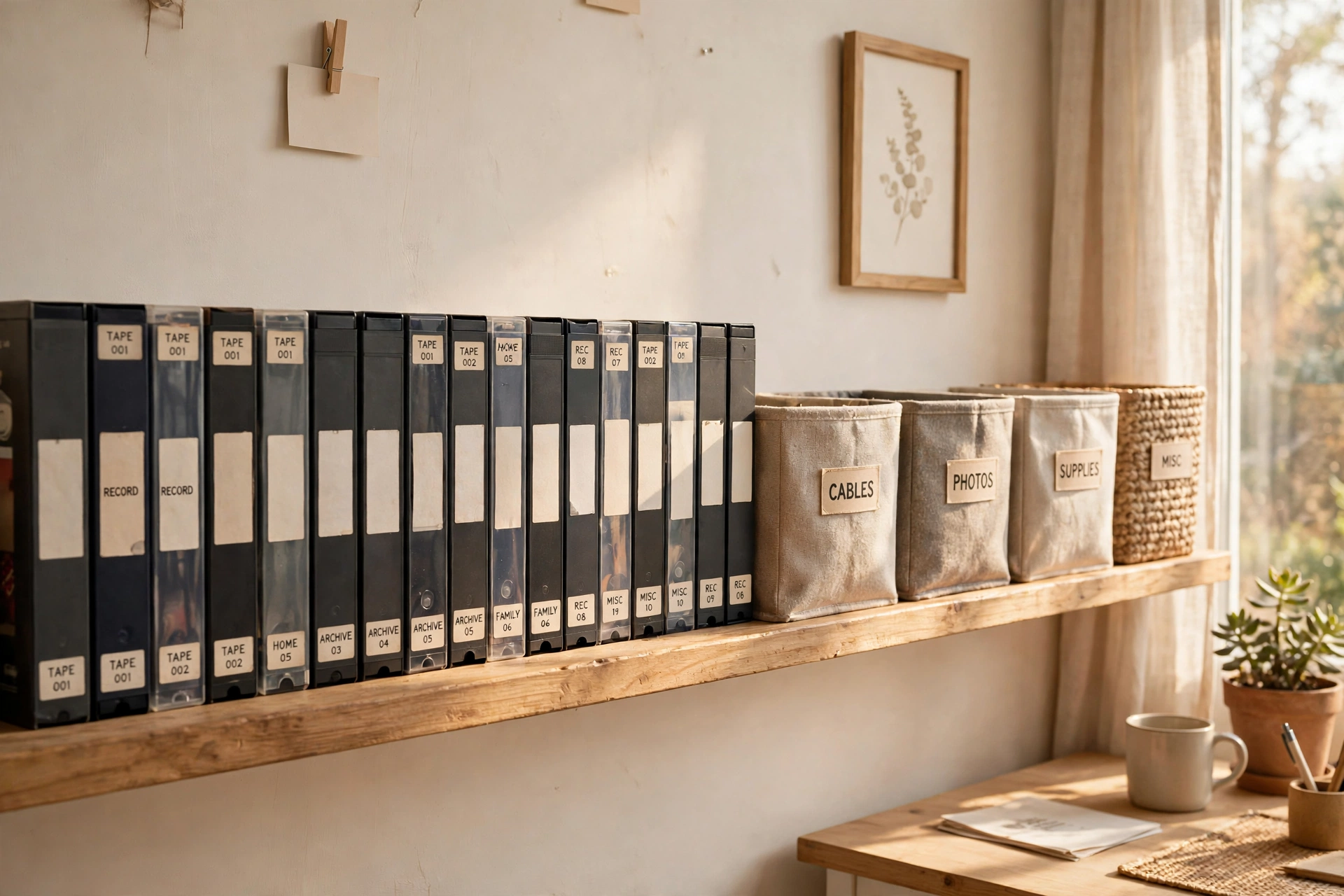
The good news is that the plan is simple. You do not need special archive rooms or pricey gear. You need tapes standing upright, in cases, on a dry shelf, with labels you can read — and a clear choice about which tapes to digitize before they fade. That is what these VHS storage ideas are for.
Why VHS Tapes Need a Real Storage Plan
A VHS tape is not like a book. A book can sit in a damp box for years and still read fine. A VHS tape cannot. Inside the black plastic shell is a thin ribbon coated with tiny magnetic particles, and those particles hold the picture and sound.
Heat makes the coating loosen. Damp lets mold grow on the ribbon. A strong magnet nearby can blur the recording. None of this shows on the outside, so a tape can look fine and play back like a snowstorm.
Learning how to store vhs tapes starts with accepting that the tapes are on a clock. Even tapes kept in good shape slowly lose quality over decades, and tapes from the 1980s and 1990s are already 30 to 40 years old. Good storage buys time. It does not buy forever. That is why the plan below has two halves: keep the tapes safe now, and digitize the ones that matter before the clock runs out.
The other reason tapes need a plan is simpler: nobody can find anything. Most collections grew by accident. A tape came home from a party, got tossed on a shelf, and stayed there.
Ten years later there are forty tapes and no list. The fix is not a bigger box. It is one shelf, one rule for labels, and one bin for the tapes you are done deciding about. These vhs tape storage ideas for home movies work whether you have ten tapes or a hundred.
7 VHS Storage Ideas That Actually Work
These seven VHS storage ideas cover the whole job, from the tape you watch every Christmas to the box of unlabeled tapes you inherited from your parents. Pick the ones that fit your collection. You do not need all seven on day one — you need the tapes upright, the labels readable, and the digitize pile started.
1. Store Tapes Upright, Like Books
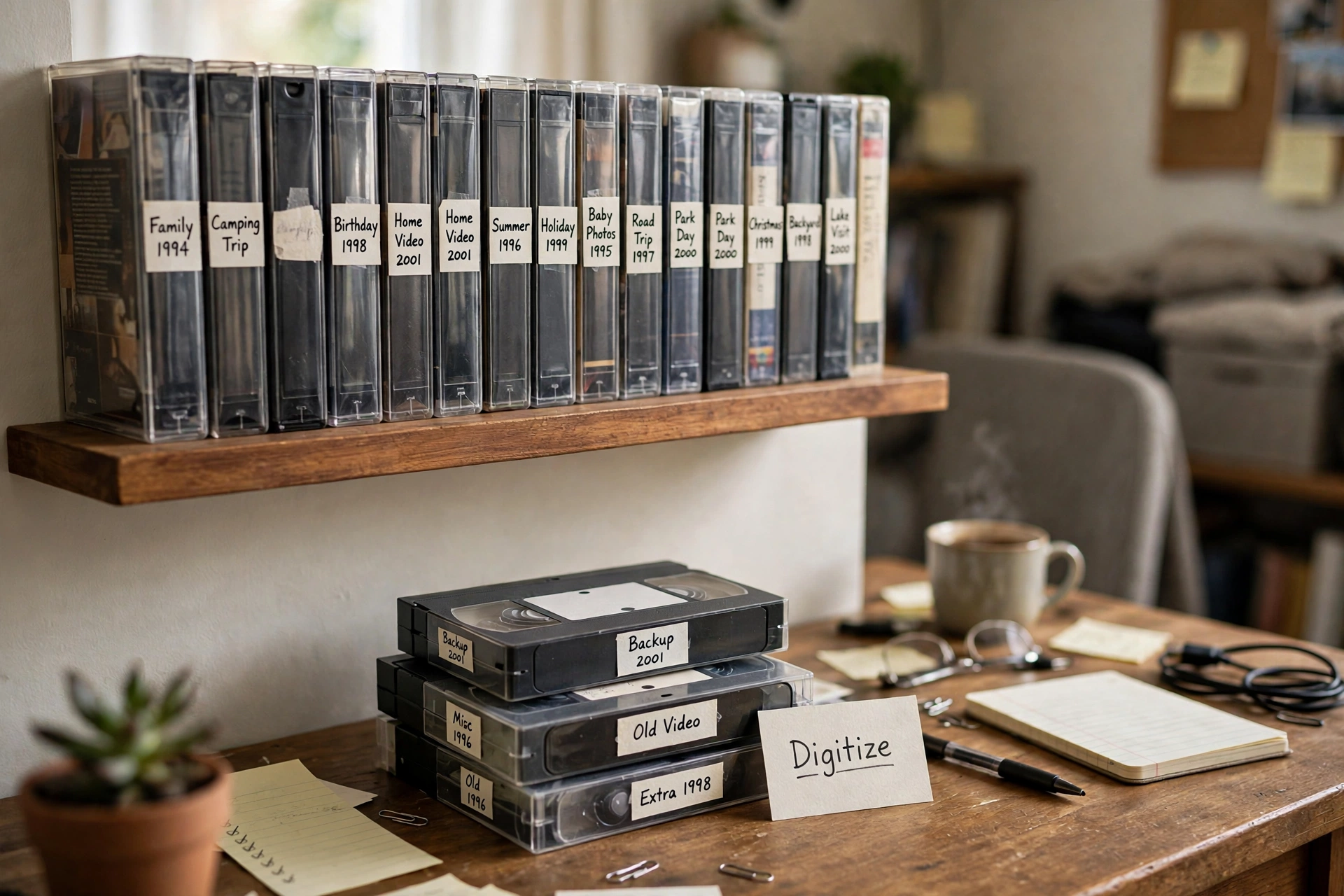
Storing vhs tapes upright is the single most useful habit in this whole list. Stand each tape on its long edge, spine out, the way books stand on a shelf. A bookend or a small divider keeps the row from leaning. Flat stacking is the mistake to avoid: the weight of a tall stack presses unevenly on the tape pack inside, and over time that can warp the shell and stretch the ribbon.
A shelf with a lip or a low rail helps too, because tapes slide. That is why storing vhs tapes upright sits at the top of these VHS storage ideas. If the row is short, a simple bookend does the job. If you use a box instead of a shelf, stand the tapes upright inside the box, packed snug enough that they cannot tip but loose enough that you can pull one out without dragging three more with it.
2. Keep the Case, or Replace It
VHS tape cases are not just packaging. The hard plastic shell keeps dust out, keeps the tape from getting knocked, and keeps the ribbon from catching on anything. A tape with its case will outlast a bare tape on the same shelf every time.
So the first job is to match every tape to a case. Good VHS storage ideas start with the case, not the shelf. If a case is cracked, swap it for a clean spare. If a tape has no case at all, buy a few plain replacement cases — they cost little and they are the cheapest protection a tape gets.
Sleeves are the backup option. A paper sleeve is better than nothing, but it does not protect the shell from a knock, and a cheap cardboard sleeve can hold damp against the tape. For tapes you plan to keep for years, a hard case wins. For tapes on their way to being digitized, a sleeve is fine as a short-term home.
3. Give Every Tape a Labeled Home
A tape without a label is a tape nobody will ever watch. Labels are the part most people skip, and they are the part that makes the whole system work. Write the year, the event, and the people on the spine label in plain words: “1998 — Sarah’s 5th birthday” beats “Tape 12” every time. If the original label is faded, stick a fresh one over it and copy what you can still read.
Labels are the quiet half of VHS storage ideas, and a vhs tape organizer does not have to be fancy. A shelf with a small label at the start of each row works: “Family 1990–1995”, “Holidays”, “School plays”. The point is that anyone in the house can walk to the shelf and find the right tape in under a minute. When a tape has no home, it ends up on top of the pile, and the pile is where tapes go to be forgotten.
4. Sort First: Digitize or Keep
Before you buy a single box, sort the tapes into two piles: digitize and keep. The digitize pile holds the irreplaceable stuff — weddings, birthdays, grandparents, first steps. The keep pile holds the rest: the movie you recorded off TV, the tape with two minutes of a school play and an hour of static. Digitize vhs tapes from the first pile before you spend money storing the second pile, because a digital file does not fade the way a tape does.
This is also the moment to be honest about duplicates. Three copies of the same Christmas morning is two copies too many. Keep the best one, digitize it, and let the others go. The shelf space you save is real, and the tapes you keep get better care because there are fewer of them.
5. One Bin Per Era or Family Event
A vhs tape storage bin works when it holds one clear group and nothing else. One bin for the 1990s family tapes. One bin for holidays. One bin for the tapes that belong to the kids.
When a bin holds a mix of everything, it is just a smaller version of the pile you started with. The best VHS storage ideas keep groups apart like this. Label the outside of the bin in big letters, and put the newest tapes at the front so the bin stays in order without a second thought.
Pick bins with lids that fit, but do not seal them tight with tape. A lid keeps dust out. A sealed plastic bag inside the bin traps damp in. The bin should breathe a little, sit off the floor, and live on a shelf or a table — never directly on a basement floor, where a small leak reaches it first.
6. Pick the Right Room
Where to store vhs tapes matters more than which box you buy. The best spot is a room people live in: a home office, a spare bedroom, an inside closet with a door. Steady temperature, low damp, no direct sun. The worst spots are the attic, the garage, and the damp basement — the places where summer heat and winter cold swing hardest, and where a leak can sit unnoticed for weeks.
That is why VHS storage ideas always start with the room, not the box. Capture’s guide to storing and preserving VHS tapes gives the same numbers — 65°F or below and 30–50% humidity — and it is worth a read before you pick a shelf: https://www.capture.com/blog/how-to-store-and-preserve-vhs-tapes. Keep the tapes away from speakers, old TVs, and anything with a strong magnet, and keep them out of direct sunlight. A closed cabinet or a shelf inside a closet does the job well, and it hides the collection at the same time.
7. A Small Cabinet Beats a Big Pile
A vhs tape storage cabinet does not need to be a special piece of furniture. A small bookcase with doors, a low cabinet in the home office, or a set of cube shelves all work. What matters is that the tapes stand upright, the shelves are shallow enough that tapes do not hide behind each other, and the whole thing sits in that cool, dry room from the last idea.
Shallow shelves are the trick. A shelf one tape deep means every spine is visible and every tape is reachable. A deep shelf means a front row and a lost back row, and the back row is where the tapes nobody can find live. If you only have deep shelves, put a small riser or a row of bins at the back so nothing hides.
These VHS storage ideas work as a set, and they work in order: upright, cased, labeled, sorted, binned, in the right room, on a shallow shelf. Do them in that order and the collection stops being a mystery box.
Where Tapes Should Live — and Where They Should Not
| Spot | Good or bad? | Why |
|---|---|---|
| Home office shelf | Good | Steady temperature, dry, easy to reach |
| Inside closet, upper shelf | Good | Dark, stable, off the floor |
| Low cabinet with doors | Good | Keeps dust and sunlight out |
| Attic | Bad | Summer heat warps shells and tape |
| Damp basement | Bad | Damp grows mold on the ribbon |
| Garage | Bad | Heat swings and dust, plus damp in winter |
| On top of a speaker | Bad | Magnets can blur the recording |
| Stacked flat in a box | Bad | Weight presses unevenly on the tape pack |
Mistakes That Ruin VHS Tapes
Most damaged tapes were not damaged by age alone. They were damaged by small habits that are easy to fix. The best VHS storage ideas avoid these mistakes from the start:
- Stacking tapes flat in tall piles, so the bottom tapes carry the weight of all the rest.
- Storing tapes in the attic or garage, where heat and damp swing with the seasons.
- Leaving a tape in the VCR after watching, where it sits under tension and near the machine’s magnets.
- Tossing bare tapes into a drawer without cases, where shells crack and dust gets inside.
- Using a rubber band or tight wrap to hold a case shut, which can dent the shell over time.
- Putting tapes in a sealed plastic bag, which traps any damp inside with the tape.
- Buying a vhs tape storage box made of plain cardboard, which soaks up damp and does little to protect the tapes inside.
Check your own collection against that list. Most people find two or three of these on their shelf right now, and each one takes five minutes to fix.
A 15-Minute VHS Sort You Can Do Today
You do not need a free weekend to start. Fifteen minutes and a table are enough:
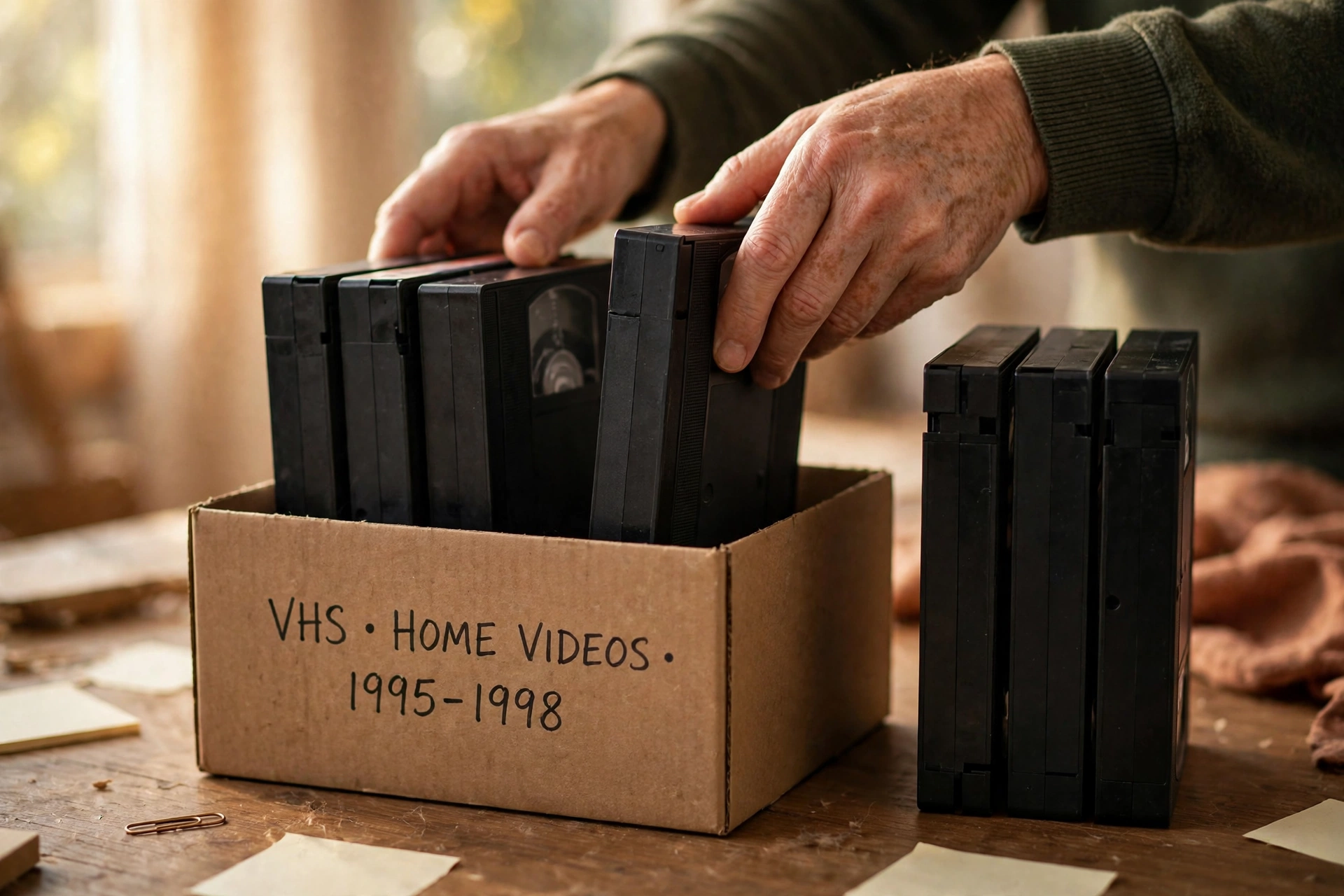
- Pull every tape out of its hiding spots and put them on one table.
- Stand them upright in rows, spines out, and throw away any cracked or empty cases.
- Label every tape you can identify, even roughly — year and event are enough.
- Make two piles: digitize (the irreplaceable family movies) and keep (everything else).
- Put the digitize pile in one labeled box and set a date to get it converted.
- Put the keep pile on one shelf, upright, in cases, with a row label.
That is the whole system, and these VHS storage ideas work best when the sort comes first. If you want vhs tape shelf ideas that grow with the collection, start with one shelf and one rule: nothing new goes on the shelf without a label. A shelf that follows that rule stays tidy on its own, because every tape that arrives already has a home.
VHS Storage Ideas for Other Formats in the House
Most homes with VHS tapes have other old formats too, and they need the same care. These VHS storage ideas translate to other formats as well. The same upright, cased, labeled, cool-and-dry rules apply to them, with small differences. Our dvd storage ideas post covers discs in sleeves and cases, our cd storage ideas post covers music collections, and our cassette storage ideas post covers audio tapes — which share the same magnetic-tape care as VHS, just in a smaller shell. If you have all four formats, sort them the same afternoon and give each one its own shelf or bin, so a DVD never ends up buried under a stack of VHS tapes.
Frequently Asked Questions
How should I store VHS tapes at home?
Store them upright on their long edge, in their cases, on a shelf in a cool, dry room — a home office or an inside closet is ideal. Keep them out of direct sunlight, away from magnets and speakers, and off the floor. The simplest vhs storage ideas start with that one shelf, and they work for collections of any size.
Can VHS tapes be stored flat?
You can, but you should not. Flat stacking puts uneven weight on the tape pack, and a tall stack can warp the shells at the bottom over time. Upright storage keeps the weight off the ribbon and lets you read every spine at a glance. If you must use a box, stand the tapes upright inside it.
How long do VHS tapes last?
Most tapes last 10 to 25 years before the picture starts to fade, and even well-stored tapes from the 1980s and 1990s are now in the window where quality drops. Storage buys time — it does not stop the clock. That is why digitizing the family movies matters more than finding the perfect box.
Should I keep my VHS tapes after digitizing them?
Yes, keep the originals until you have opened every digital file, checked the picture and sound at the start, middle, and end, and made two backup copies in different places. After that, the tapes are a backup of a backup. Keep the ones with real family history and let the duplicates and blank tapes go.
A Small Shelf, a Clear Label, and a Plan
VHS tapes are not like other clutter. They hold birthdays, weddings, and voices you cannot get back any other way, and they are quietly fading while they sit in a box. The fix is not a big project. Stand the tapes up, put them in cases, label them in plain words, and pick the few that matter most to digitize first.
These VHS storage ideas keep the tapes safe while you decide, and they make the decision easy, because once every tape is labeled and on one shelf, you can finally see what you actually have. Start with fifteen minutes today — pull the tapes out, stand them up, and label the first row. The rest of the shelf will follow.